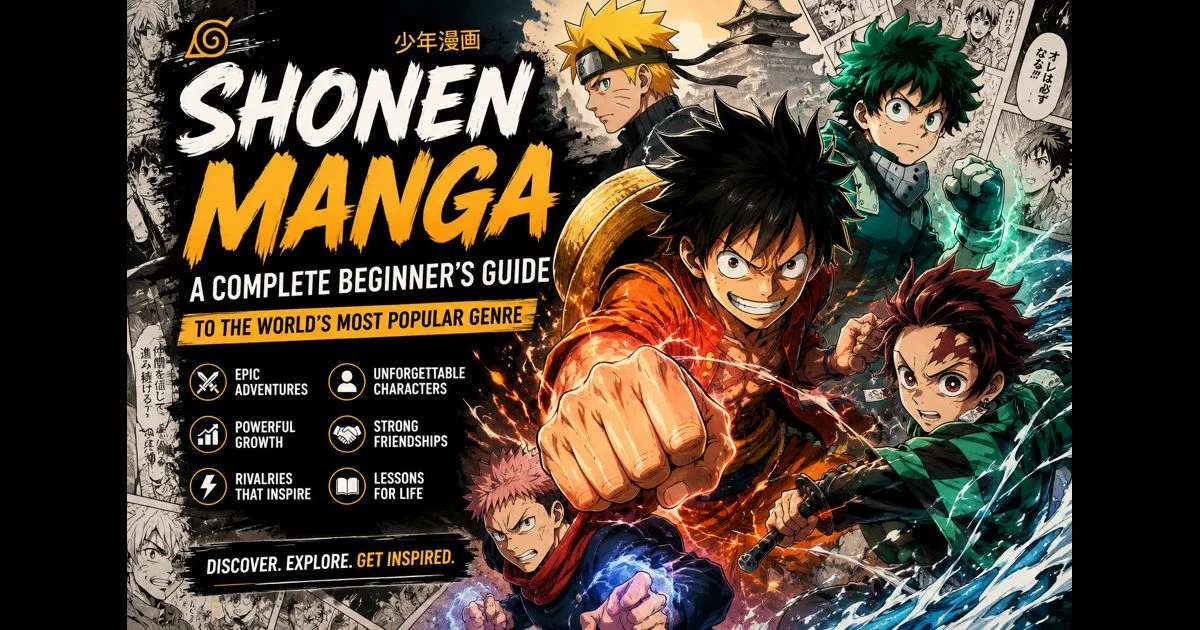
For many readers, shonen manga serves as the gateway into Japanese comics. Its exciting adventures, memorable characters, emotional storytelling, and imaginative worlds have introduced millions of people to manga, making it one of the most influential publishing categories in modern entertainment.
Although shonen is often associated with spectacular battles and powerful heroes, its lasting popularity comes from something much deeper. At its heart, shonen tells stories about determination, friendship, personal growth, and overcoming challenges through perseverance. Readers follow characters as they learn from failure, build meaningful relationships, and gradually become stronger—not only physically but emotionally as well.
Over several decades, shonen manga has shaped animation, games, films, and popular culture across the world. Its storytelling techniques continue to inspire creators far beyond Japan while attracting new readers from every age group.
Whether you’re completely new to manga or looking to better understand why shonen remains so influential, this guide explores its history, defining characteristics, storytelling methods, and practical tips for beginning your own reading journey.
What Does Shonen Really Mean?
One of the most common misunderstandings is that shonen refers to a specific type of story.
In reality, shonen originally describes a publishing demographic rather than a genre.
The word simply indicates that a manga was primarily published for younger male readers.
However, this does not limit who can enjoy these stories.
Today, readers of different ages and backgrounds appreciate shonen because its themes are widely relatable.
Adventure, determination, friendship, responsibility, and personal growth resonate far beyond any single audience.
Understanding this distinction helps readers appreciate the diversity that exists within shonen rather than expecting every series to follow the same formula.
How Shonen Manga Became So Popular
Shonen’s international success developed gradually over many decades.
As Japanese manga became more widely translated and officially distributed, readers discovered stories that combined exciting action with emotionally satisfying character development.
Several factors contributed to its global appeal:
- Memorable protagonists.
- Long-term character growth.
- Creative fictional worlds.
- Consistent storytelling.
- Emotional relationships.
- Dynamic artwork.
- Accessible themes.
- Adaptations into successful anime series.
These qualities helped shonen expand beyond its original audience, becoming one of the world’s most recognizable forms of illustrated storytelling.
The Core Principles of Shonen Storytelling
Although every series is unique, many successful shonen manga share several storytelling foundations.
These principles create familiar structures while allowing creators enormous creative freedom.
Common characteristics include:
- A determined protagonist.
- Meaningful personal goals.
- Strong friendships.
- Worthy rivals.
- Continuous improvement.
- Challenging obstacles.
- Emotional victories.
- Lessons learned through experience.
Importantly, success rarely comes easily.
Characters typically overcome repeated setbacks before achieving meaningful progress.
This gradual development encourages readers to celebrate growth rather than immediate perfection.
Character Growth Drives Every Great Shonen Series
Perhaps the defining feature of shonen is character development.
Readers watch protagonists evolve over long periods rather than mastering every challenge immediately.
Growth often occurs through:
- Hard work.
- Practice.
- Mentorship.
- Failure.
- Self-reflection.
- New experiences.
- Cooperation.
- Personal responsibility.
This progression creates emotional investment because readers witness every stage of the journey.
The most memorable victories feel satisfying precisely because they have been earned through perseverance.
Friendship as a Source of Strength
Unlike stories centered entirely on individual achievement, many shonen series emphasize teamwork and meaningful relationships.
Friends are rarely included simply as supporting characters.
Instead, they influence important decisions, encourage personal growth, and challenge the protagonist to become a better person.
These relationships frequently demonstrate values such as:
- Trust.
- Loyalty.
- Respect.
- Cooperation.
- Sacrifice.
- Encouragement.
- Shared responsibility.
Rather than weakening the main character, strong friendships often become one of their greatest strengths.
This focus on cooperation has become one of shonen’s most recognizable storytelling traditions.
Rivals Help Characters Improve
Few storytelling elements are as closely associated with shonen as memorable rivalries.
A well-written rival does far more than create competition.
They encourage the protagonist to question their abilities, improve their skills, and reconsider their beliefs.
Strong rivals often:
- Challenge personal limits.
- Introduce different perspectives.
- Create healthy competition.
- Inspire continuous improvement.
- Push both characters toward growth.
Many of manga’s most celebrated character relationships are built upon mutual respect developed through rivalry rather than simple hostility.
Adventure Keeps Readers Curious
Adventure is another defining characteristic of many shonen stories.
Whether characters travel across oceans, explore mysterious kingdoms, investigate supernatural mysteries, or compete in organized tournaments, every new location introduces opportunities for growth.
These journeys frequently include:
- New allies.
- Dangerous opponents.
- Hidden histories.
- Cultural discoveries.
- Personal challenges.
- Unexpected responsibilities.
Exploration keeps the narrative moving while gradually expanding both the fictional world and the reader’s understanding of it.
This continuous sense of discovery helps maintain excitement even across very long-running series.
More Than Action
Although spectacular battles often receive the most attention, action alone does not explain shonen’s lasting popularity.
The strongest series balance exciting confrontations with meaningful emotional development.
Readers remember important moments because they understand:
- Why are the characters fighting?
- What they hope to protect.
- What they fear losing.
- How each challenge changes them.
Without this emotional foundation, even the most visually impressive action scenes would quickly lose their impact.
Shonen succeeds because every major conflict contributes to both the external adventure and the internal growth of its characters.
The Evolution of Shonen Manga
Shonen manga has continued to evolve with every generation of creators.
While its core values remain familiar, the way stories are written has changed significantly over time.
Earlier series often focused on straightforward adventures where heroes defeated increasingly powerful opponents through courage and determination.
Modern stories still celebrate these ideas but frequently introduce more complex characters, morally challenging situations, and deeper emotional themes.
Today’s readers often expect:
- Richer world-building.
- More layered character development.
- Longer story arcs.
- Thoughtful antagonists.
- Emotional consequences.
- Greater narrative complexity.
This evolution has allowed shonen to remain relevant while attracting entirely new generations of readers.
Classic Series That Defined the Genre
Several landmark series established many of the storytelling traditions still found in modern shonen manga.
These influential works demonstrated how long-term character growth, imaginative settings, and memorable rivalries could create lasting emotional impact.
Many classic titles introduced ideas such as:
- Tournament story arcs.
- Training sequences.
- Team-based adventures.
- Progressive power systems.
- Large interconnected worlds.
- Long-running character development.
These storytelling foundations continue to influence creators across manga, anime, and other forms of entertainment.
Even readers discovering modern series often recognize techniques first popularized by earlier generations of shonen creators.
Modern Shonen Continues to Innovate
While classic storytelling remains important, contemporary shonen has expanded in many creative directions.
Recent creators frequently experiment with:
- Faster pacing.
- More emotionally complex protagonists.
- Unconventional narrative structures.
- Diverse supporting casts.
- Psychological conflict.
- Unique visual presentation.
Rather than replacing traditional storytelling, these innovations build upon established foundations while introducing fresh ideas that reflect changing reader interests.
As a result, modern shonen offers far greater variety than many newcomers initially expect.
Power Systems Add Strategy
Many popular shonen series include unique systems that define how characters develop their abilities.
These systems do more than determine who is strongest.
They establish consistent rules that shape both conflict and strategy throughout the story.
Effective power systems usually include:
- Clear limitations.
- Opportunities for creativity.
- Gradual progression.
- Different specializations.
- Balanced strengths and weaknesses.
- Meaningful consequences.
When these rules remain consistent, readers become invested because victories depend on intelligence, preparation, and determination rather than convenience.
World-Building Supports Every Adventure
Shonen stories often unfold across expansive fictional worlds filled with unique cultures, organizations, histories, and traditions.
Strong world-building makes each new location feel meaningful instead of existing only as a setting for the next battle.
Effective fictional worlds often include:
- Distinct locations.
- Historical events.
- Social structures.
- Cultural traditions.
- Political systems.
- Original creatures.
- Meaningful geography.
- Consistent internal rules.
Gradually revealing these elements encourages readers to remain curious while making every new discovery feel rewarding.
Memorable Villains Strengthen the Story
Great antagonists challenge far more than a protagonist’s physical abilities.
The strongest opponents often question the hero’s beliefs, values, and understanding of the world.
Rather than existing solely to create conflict, memorable villains usually possess:
- Clear motivations.
- Personal philosophies.
- Convincing goals.
- Emotional complexity.
- Connections to the protagonist.
- Meaningful influence on the story.
When readers understand why an antagonist acts as they do, conflicts become more engaging because every confrontation carries both emotional and philosophical weight.
The Art Style of Shonen Manga
Visual storytelling plays an essential role in the success of shonen manga.
Artists use dynamic composition to create movement, energy, and emotional intensity across every chapter.
Common artistic techniques include:
- Dramatic action poses.
- Dynamic panel layouts.
- Expressive facial expressions.
- Motion effects.
- Detailed environments.
- Cinematic perspective.
- Strong visual contrast.
These elements work together to create pages that feel energetic while remaining easy to follow.
Even quieter scenes benefit from thoughtful composition that emphasizes emotional interaction rather than physical action.
Action Is About Storytelling, Not Spectacle
One reason shonen action remains memorable is that battles usually reveal character rather than existing simply for excitement.
Every confrontation becomes an opportunity for readers to learn something new.
Action scenes often demonstrate:
- Personal determination.
- Creative problem-solving.
- Leadership.
- Trust between teammates.
- Emotional growth.
- Moral choices.
This narrative purpose transforms action from visual entertainment into meaningful storytelling.
Readers become invested because every victory and defeat changes the characters in lasting ways.
Emotional Balance Keeps Stories Engaging
Despite its reputation for exciting battles, successful shonen carefully balances intensity with quieter moments.
Humor, friendship, reflection, and everyday interactions provide opportunities for readers to connect with characters outside major conflicts.
This emotional variety prevents stories from becoming repetitive while making dramatic moments feel even more powerful.
By alternating excitement with genuine human interaction, shonen creates narratives that remain emotionally satisfying across hundreds of chapters.
Shonen Manga Beyond Japan
What began as a publishing category in Japan has grown into a worldwide cultural phenomenon.
Today, shonen manga is read in dozens of languages and enjoyed by readers from many different backgrounds.
Its influence extends well beyond printed pages.
Shonen storytelling has inspired:
- Television animation.
- Feature films.
- Video games.
- Novels.
- Collectible merchandise.
- Fashion collaborations.
- Fan communities.
- Creative artwork.
As digital publishing has expanded, official releases have become more accessible, allowing international readers to experience new chapters much closer to their original publication.
Building Global Fan Communities
One of shonen’s greatest strengths is its ability to bring people together.
Readers regularly discuss favorite characters, theories, memorable story arcs, and future developments through online communities and local events.
Fans often participate by:
- Sharing artwork.
- Creating cosplay.
- Discussing story theories.
- Recommending series.
- Collecting merchandise.
- Attending conventions.
- Organizing reading groups.
These communities encourage readers to explore new series while creating friendships based on shared interests.
The enthusiasm surrounding shonen often extends far beyond simply reading manga.
Common Misconceptions About Shonen
Many newcomers develop inaccurate expectations about shonen because of its popularity.
Understanding a few common misconceptions makes exploring the genre much easier.
Shonen Is Only About Fighting
Action certainly plays an important role in many series.
However, friendship, responsibility, family, hope, perseverance, humor, and emotional development often receive just as much attention.
Some of the most memorable moments involve quiet conversations rather than dramatic battles.
Only Teenagers Read Shonen
Although the demographic originally targeted younger readers, millions of adults continue enjoying shonen because of its engaging storytelling and relatable themes.
Strong characters and meaningful narratives appeal to readers regardless of age.
Every Shonen Story Is the Same
No two series approach storytelling in exactly the same way.
Some emphasize fantasy.
Others focus on sports, mystery, science fiction, historical settings, or everyday life.
The diversity within shonen is far greater than many people initially realize.
How Beginners Should Start Reading
New readers often feel overwhelmed by the number of available series.
Fortunately, there is no single correct starting point.
Instead of choosing the longest or most popular title immediately, begin with stories that match your interests.
Consider what you enjoy most:
- Adventure.
- Fantasy.
- Supernatural mysteries.
- Sports.
- Science fiction.
- Historical settings.
- Comedy.
- School life.
Starting with subjects you already enjoy makes it easier to appreciate the storytelling style that defines shonen.
Reading at Your Own Pace
Some famous series contain hundreds of chapters, while others are much shorter.
New readers should never feel pressured to finish everything immediately.
A comfortable reading pace allows more time to appreciate:
- Character development.
- World-building.
- Story structure.
- Artwork.
- Emotional moments.
- Creative details.
Enjoying the journey is far more rewarding than simply reaching the ending as quickly as possible.
Exploring Beyond Popular Recommendations
Well-known series provide excellent introductions, but they represent only a portion of what shonen offers.
As readers become familiar with the genre, exploring lesser-known titles often leads to surprising discoveries.
Trying different series helps readers experience:
- Different artistic styles.
- Unique storytelling approaches.
- Original fictional worlds.
- Creative power systems.
- Diverse character dynamics.
Expanding beyond the most famous works also provides a broader understanding of how varied shonen storytelling has become over the years.
Finding the Right Series for You
The best shonen manga is not necessarily the highest-selling one.
It is the series that connects most strongly with your own interests.
Some readers enjoy long adventures filled with exploration.
Others prefer fast-paced action, emotional drama, sports competition, or character-driven mysteries.
Reading sample chapters before committing to a longer series can help determine whether a story’s pacing, artwork, and characters match your preferences.
Over time, readers naturally develop a clearer understanding of the themes and storytelling styles they enjoy most.
Why Shonen Continues to Inspire Readers
Decades after becoming one of Japan’s most influential publishing categories, shonen remains popular because its central ideas never lose relevance.
People continue connecting with stories about:
- Working toward meaningful goals.
- Learning through failure.
- Supporting friends.
- Facing fears.
- Growing through experience.
- Protecting what matters.
These universal themes allow every new generation of readers to find inspiration within stories that celebrate determination, resilience, and hope.
Whether set in magical kingdoms, futuristic cities, sports arenas, or ordinary schools, shonen continues reminding readers that meaningful growth comes through perseverance, compassion, and the courage to keep moving forward.
The Future of Shonen Manga
Shonen manga continues to evolve alongside changing reader expectations and advances in digital publishing.
While its core themes remain timeless, creators are exploring new storytelling approaches, introducing more diverse characters, experimenting with different narrative structures, and presenting increasingly imaginative fictional worlds.
Several trends are shaping the future of the genre, including:
- Simultaneous global digital releases.
- Greater international readership.
- Expanded digital publishing platforms.
- More diverse storytelling styles.
- Improved official translations.
- Enhanced accessibility across devices.
- Creative collaborations across media.
These developments are helping new generations of readers discover shonen while giving established fans more ways to enjoy their favorite series.
Digital Reading Is Expanding Access
Official digital services have made shonen manga more accessible than ever before.
Readers can now discover new series, follow ongoing chapters, and build personal digital libraries without waiting for printed editions to become available.
Modern reading platforms often provide:
- Personalized recommendations.
- Cross-device synchronization.
- Offline reading.
- Organized collections.
- Faster chapter availability.
- Improved reading interfaces.
These improvements make it easier for both newcomers and experienced readers to explore a wide variety of series while supporting official publishers and creators.
Why Shonen Remains Popular Across Generations
Many entertainment trends come and go, yet shonen continues attracting readers decade after decade.
Its lasting popularity comes from storytelling that focuses on experiences nearly everyone understands.
Readers connect with characters who:
- Work hard to improve.
- Learn from mistakes.
- Build lasting friendships.
- Face difficult choices.
- Continue moving forward despite setbacks.
Although settings and artistic styles may change, these themes remain meaningful regardless of culture, language, or generation.
This universal appeal explains why so many classic shonen series continue attracting new readers years after their original publication.
Expanding Beyond Your First Series
Many readers begin with one well-known title before gradually discovering the incredible diversity that exists within shonen.
After completing an introductory series, consider exploring stories that offer different experiences.
For example:
- Fantasy adventures.
- Sports competitions.
- Historical settings.
- Science fiction.
- Supernatural mysteries.
- School-based stories.
- Character-driven dramas.
- Comedy-focused adventures.
Exploring different storytelling styles provides a broader appreciation of how flexible the shonen category has become.
Building a Lifelong Reading Journey
Shonen is often the beginning of a reader’s manga journey rather than the destination.
As reading interests develop, many fans naturally expand into other demographics and genres while continuing to appreciate the optimism, emotional growth, and memorable storytelling that first attracted them.
Reading widely helps readers:
- Discover new creators.
- Appreciate different artistic techniques.
- Understand diverse storytelling styles.
- Develop broader literary interests.
- Find unexpected personal favorites.
Keeping an open mind often leads to the most rewarding discoveries.
Final Thoughts
Shonen manga has earned its worldwide popularity by combining exciting adventures with meaningful human experiences. While thrilling action and imaginative worlds capture readers’ attention, it is the emotional journeys, lasting friendships, personal growth, and determination of its characters that leave the strongest impression.
Understanding what defines shonen helps readers appreciate that it is far more than a collection of action-packed stories. It is a publishing tradition built around hope, perseverance, curiosity, and the belief that people can continue growing through effort and experience.
Whether you’re beginning your first manga series or expanding an existing collection, shonen offers countless opportunities to discover unforgettable characters, imaginative worlds, and stories that continue inspiring readers around the globe.
The best way to understand why the genre remains so influential is simply to begin reading. Every series offers a different adventure, and each one has the potential to introduce you to another side of manga’s remarkable storytelling tradition.
Frequently Asked Questions
What is shonen manga?
Shonen manga is a publishing category traditionally created for younger male readers, but it is enjoyed by people of all ages. It commonly features adventure, personal growth, friendship, competition, and exciting storytelling.
Is shonen only for teenagers?
No. Although shonen originally targeted younger audiences, its universal themes, memorable characters, and engaging stories have attracted readers from many age groups around the world.
What makes shonen different from other manga?
Shonen often emphasizes character growth, determination, teamwork, rivalry, and adventure. While action is common, many series also explore emotional relationships, personal responsibility, and long-term character development.
Which shonen manga should beginners read?
The best starting point depends on personal interests. Readers who enjoy adventure, fantasy, sports, mystery, or science fiction can all find beginner-friendly shonen series that match their preferences. Choosing a story based on your interests usually creates a more enjoyable reading experience.
Are all shonen manga long-running series?
No. While some famous titles contain hundreds of chapters, many excellent shonen manga are much shorter. Readers can choose series that fit their available time and preferred storytelling pace.
Why is shonen manga so popular worldwide?
Its combination of exciting adventures, relatable characters, emotional storytelling, imaginative worlds, and universal themes has helped shonen connect with readers across different cultures and generations, making it one of the most influential forms of modern illustrated storytelling.