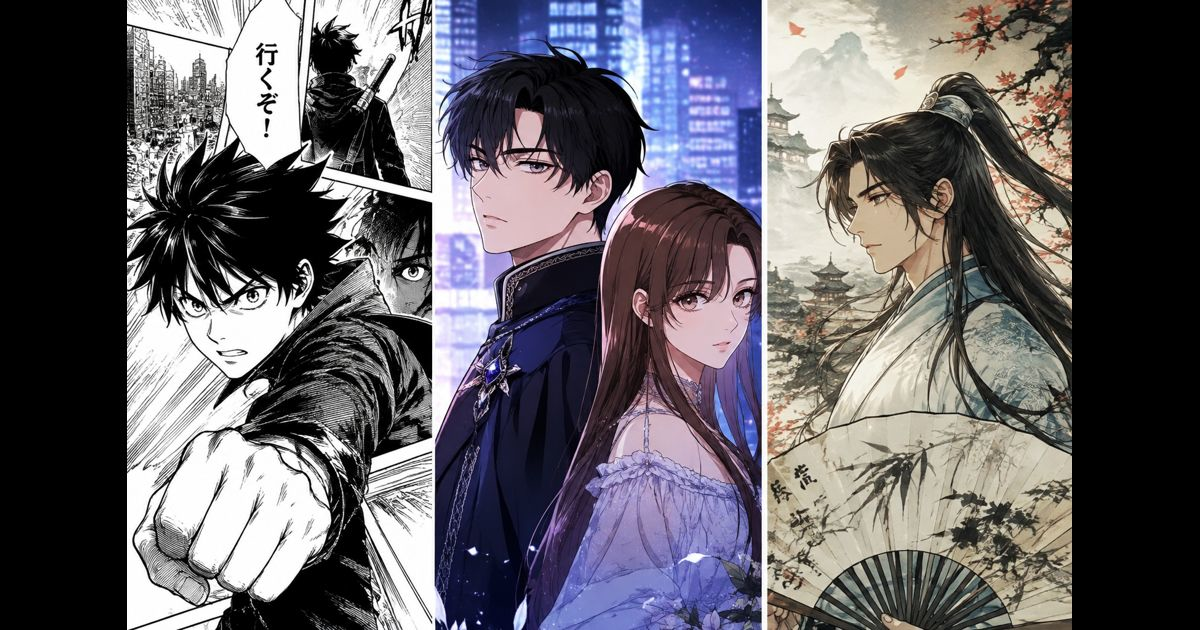
Manga vs manhwa vs manhua is primarily a distinction based on origin. Manga refers to comics from Japan, manhwa to comics from Korea, and manhua to Chinese comics commonly associated with mainland China, Taiwan, and Hong Kong.
Their presentation can also differ. Japanese manga is commonly published in black and white and read from right to left. Much of the Korean manhwa available internationally is published in color and designed for vertical scrolling. Modern digital manhua is also frequently presented in color, but its reading direction varies by region and format.
These are common patterns rather than fixed rules. Country of origin remains the most reliable way to distinguish the three.
Manga vs Manhwa vs Manhua at a Glance
|
Feature |
Manga |
Manhwa |
Manhua |
|
Origin |
Japan |
Korea |
Mainland China, Taiwan, or Hong Kong |
|
Common print direction |
Right to left |
Usually left to right |
Varies by region |
|
Common digital direction |
Page-based or vertical |
Often vertical scrolling |
Page-based or vertical |
|
Typical color use |
Usually black and white |
Digital releases are often in color |
Digital releases are often in color |
|
Common format |
Serialized chapters and collected volumes |
Digital episodes, print chapters, or collected volumes |
Digital episodes, print chapters, or collected volumes |
|
Strongest identifying factor |
Japanese origin |
Korean origin |
Chinese origin |
Reading direction, color, artwork, and layout provide useful clues, but none can identify every title correctly. The original publisher, creator, language, and country of release provide stronger evidence.
Manga Comes from Japan
Manga refers to comics created within Japan’s publishing and artistic traditions. In Japan, the word may be used broadly for comics, while international readers normally use it specifically for Japanese comics.
Traditional manga is usually read from right to left. The reader begins on the right-hand side of the book, follows panels across the page toward the left, and then continues downward. Most licensed English editions preserve this arrangement instead of reversing the original artwork.
Many manga series are initially released one chapter at a time through print magazines or digital publications. Successful chapters may later be collected into paperback volumes. However, manga can also be released directly through websites, mobile apps, independent publications, and complete standalone books.
Manga Is Usually Black and White
Most serialized manga uses black-and-white artwork. This approach supports frequent publishing schedules and reduces the cost of printing large magazines and paperback collections.
Artists create depth and atmosphere through:
- Detailed line work
- Shading patterns
- Solid black areas
- Crosshatching
- Motion lines
- Light and shadow
- Carefully controlled empty space
Color may still appear on covers, opening pages, promotional illustrations, digital editions, and special releases. Some Japanese comics are produced entirely in color. A color comic from Japan can therefore still be manga.
Origin determines the classification more reliably than the use of color.
Manga Is Not a Single Genre
Manga is a storytelling medium rather than one type of story. It includes action, romance, fantasy, mystery, comedy, science fiction, history, sports, everyday drama, and many other subjects.
Japanese publishers also organize some works according to their intended readership. These publishing categories can influence tone, presentation, and magazine placement, but they do not determine who is allowed to enjoy a story.
The broader system of manga genres operates alongside audience categories. A single series may combine fantasy, comedy, romance, mystery, and personal drama without fitting into one narrow group.
Well-known examples of manga include One Piece, Sailor Moon, Spy x Family, Vagabond, and Frieren: Beyond Journey’s End. Their stories and visual approaches are very different, but all belong to the Japanese manga tradition.
Manhwa Comes from Korea
Manhwa refers to Korean comics. Internationally available manhwa is mainly associated with South Korea because its publishers and digital platforms distribute a large number of translated titles.
Korean comics existed in print long before vertical mobile reading became popular. Traditional print manhwa can use conventional pages, left-to-right reading, and either black-and-white or color artwork.
The international understanding of manhwa changed as South Korea’s digital-comic industry expanded. Many of the most widely recognized Korean titles are now released as long, full-color episodes designed to be read on smartphones.
Why Digital Manhwa Often Uses Vertical Scrolling
A vertical layout gives creators different ways to control timing and movement. Instead of relying on page turns, artists can use the distance between panels to create suspense, silence, speed, or surprise.
A character may appear alone at the top of the screen, followed by a large empty space before an important event is revealed. A long action sequence may move continuously down the screen, creating a sense of falling, chasing, or rapid movement.
Modern digital manhwa commonly includes:
- Full-color illustrations
- Long vertical episodes
- Large gaps between important panels
- Phone-friendly speech balloons
- Dramatic lighting and visual effects
- Season-based publication schedules
- Carefully timed scrolling reveals
These features are common, but they do not define every manhwa. Printed Korean comics and some current digital works use different layouts and coloring methods.
Popular examples include Solo Leveling, Tower of God, The Remarried Empress, and Omniscient Reader. Some of these titles are available in both their original scrolling format and reformatted print editions.
Manhua Comes from Chinese Publishing Traditions
Manhua refers to comics produced within Chinese publishing cultures, including works from mainland China, Taiwan, and Hong Kong.
This category contains considerable regional variation. Manhua may be published in newspapers, magazines, paperback volumes, websites, or mobile applications. Some works use traditional page layouts, while others are designed for continuous vertical scrolling.
Modern digital manhua is frequently produced in color. Printed and historical works may use black-and-white artwork, limited color, or fully painted pages.
Manhua Does Not Have One Reading Direction
Manhua cannot be assigned one universal reading direction. Its layout depends on the region, publisher, original language format, publication period, and platform.
Common arrangements include:
- Mainland Chinese editions that read from left to right
- Taiwanese and Hong Kong editions that may read from right to left
- Digital series that scroll from top to bottom
- Translated releases adapted to a platform’s standard reader
Readers should follow the panel arrangement and speech-balloon order instead of assuming that every manhua uses the same direction.
If a page initially seems confusing, character movement, speech-balloon placement, and the visual sequence of events usually reveal the intended order.
Stories Commonly Found in Manhua
Manhua covers romance, comedy, action, crime, science fiction, history, everyday life, and many other forms of storytelling.
International readers frequently encounter Chinese comics based on:
- Martial-arts adventures
- Historical conflicts
- Chinese mythology
- Spiritual cultivation
- Immortal heroes
- Palace politics
- Fantasy reincarnation
- Rival schools and clans
These subjects reflect popular parts of Chinese literature and entertainment, but they do not define manhua as a whole. A Chinese romance or modern workplace comedy is just as much manhua as a historical martial-arts epic.
Recognized examples include The King’s Avatar, Battle Through the Heavens, Blades of the Guardians, and the comic adaptation of Heaven Official’s Blessing.
Is Manhwa the Same as a Webtoon?
Manhwa and webtoon are not interchangeable.
Manhwa describes a comic’s Korean origin. Webtoon describes a digital publishing format and can also refer to services that distribute vertically scrolling comics.
The relationship can be understood through four points:
- A Korean print comic can be manhwa without being a webtoon.
- A Korean vertical-scroll comic can be both manhwa and a webtoon.
- A webtoon created outside Korea is not automatically manhwa.
- Manga and manhua can also use vertical-scroll layouts.
The confusion exists because South Korea played a major role in developing and popularizing mobile-first vertical comics. Many Korean works introduced to international readers use this format, causing webtoon and manhwa to overlap in everyday conversation.
They still describe different aspects of a comic. One identifies origin; the other identifies presentation.
Reading Direction and Page Layout
Reading Manga
Most traditional Japanese manga follows these steps:
- Open the book from the right-hand side.
- Begin with the panel in the upper-right section.
- Move toward the left across the page.
- Continue downward to the next row of panels.
- Follow speech balloons using the same general direction.
Artists sometimes use unusual panel arrangements for dramatic effect. Speech-balloon placement and the progression of the scene usually make the correct sequence clear.
Reading Manhwa
Printed Korean manhwa commonly follows a left-to-right page order. Digital manhwa designed for phones is read by scrolling downward.
When a digital series is released as a physical book, its original panels may be moved, resized, divided, or combined to fit printed pages. The print edition may therefore feel different from the original mobile version.
This formatting change does not alter the comic’s Korean origin.
Reading Manhua
The correct direction depends on where and how the manhua was published.
Many mainland Chinese page-based editions read from left to right. Some works from Taiwan and Hong Kong use right-to-left layouts. Mobile-first manhua usually scrolls downward.
The publisher’s instructions should be followed whenever they are available. Readers can also use panel position, speech balloons, and character movement to determine the sequence.
Color Is a Clue, Not a Definition
A common comparison describes manga as black and white while presenting manhwa and manhua as full-color comics. This summary reflects many popular releases, but it is not a dependable rule.
Manga may be produced in color. Manhwa and manhua may be published in black and white. Printed editions can use different coloring from their digital versions, and special releases may add color to work that originally appeared in monochrome.
Color is influenced by production cost, publishing schedule, platform, artistic choice, and audience expectations. It does not establish a comic’s country of origin.
Art Style Cannot Reliably Identify the Origin
Readers sometimes try to separate the three through facial features, body proportions, hairstyles, backgrounds, or clothing design. These details can be misleading.
Artists across Japan, Korea, mainland China, Taiwan, and Hong Kong influence one another. Digital illustration software, international readership, shared production techniques, and cross-border adaptations have increased the visual overlap.
A Korean artist may create a monochrome page-based comic. A Japanese artist may publish a color vertical series. A Chinese artist may use visual techniques strongly associated with Japanese manga.
No eye shape, character design, coloring method, or type of line work belongs exclusively to one category. Official publication information is more reliable than appearance.
Story Themes Do Not Determine the Category
Certain story patterns are strongly associated with each publishing industry because successful titles inspire similar works and receive more international attention.
Japanese manga is often associated with school stories, battle adventures, sports, romance, fantasy, and everyday life. International manhwa catalogs contain many dungeon, game-system, regression, revenge, and romantic-fantasy stories. Translated manhua frequently includes cultivation, martial arts, historical fantasy, and palace drama.
These are industry trends, not classification rules.
A dungeon story created in Japan remains manga. A school romance produced in Korea remains manhwa. A modern comedy published in China remains manhua.
The subject of the story cannot replace information about its original creator and publisher.
How Translation Can Change a Comic
International editions are not always presented exactly as they first appeared. Publishers and digital platforms may modify presentation to make a work suitable for a new language, device, or physical format.
Possible changes include:
- Translated dialogue
- Replaced or redrawn sound effects
- Reformatted panels
- Different chapter divisions
- New episode titles
- Combined chapters
- Adjusted page dimensions
- Localized series names
- Additional cultural explanations
- Vertical episodes rearranged for print
Older translated editions were sometimes mirrored to create a left-to-right reading experience. This process could reverse artwork, character positions, and other visual details. Most modern manga publishers preserve the original direction instead.
Formatting and localization may change the reading experience, but they do not change the source comic’s origin.
Adaptations Do Not Change the Original Category
A comic may be adapted by a company based in another country. For example, a Korean manhwa might receive an animated adaptation produced by a Japanese studio.
The adaptation does not turn the source into manga. The original comic remains manhwa because it was created and first published within the Korean industry.
The same principle applies to television dramas, films, games, novels, and animation. Classification should be based on the original comic rather than the country responsible for a later adaptation.
How to Identify an Unfamiliar Comic
The following checks are more dependable than judging the artwork:
- Find the original publisher. Its country usually provides the clearest evidence.
- Check where the series was first released. The original platform or magazine can identify its publishing market.
- Review the creator’s official information. Creator and publisher profiles are more reliable than fan labels.
- Identify the original language. This can help separate Japanese, Korean, and Chinese releases.
- Look at the first publication record. A later translation or adaptation may obscure the original source.
- Use color and direction only as supporting clues. Neither feature can confirm the category alone.
- Do not classify it through its animated version. The adaptation and source may come from different countries.
International collaborations can make classification less straightforward. In those cases, the official publisher’s description and the market of original release usually provide the most accurate answer.
Which One Should You Read?
There is no objectively superior choice. Each category contains excellent and weak works across numerous styles.
Manga may suit readers who appreciate carefully constructed pages, black-and-white illustration, physical collections, and a large range of long-established publishing categories.
Digital manhwa may appeal to readers who prefer color artwork, smartphone reading, cinematic spacing, and stories structured around scrolling episodes.
Manhua may interest readers who enjoy Chinese cultural settings, martial-arts traditions, cultivation fantasy, historical drama, or the varied comic industries of mainland China, Taiwan, and Hong Kong.
Story quality, pacing, characters, translation, availability, and personal taste matter more than the category printed beside a title.
Frequently Asked Questions
What is the main difference between manga, manhwa, and manhua?
The main difference is origin. Manga comes from Japan, manhwa comes from Korea, and manhua comes from Chinese publishing cultures, including mainland China, Taiwan, and Hong Kong.
Are manga, manhwa, and manhua all comics?
Yes. They belong to different regional comic traditions but use illustrations, panels, dialogue, and sequential storytelling to communicate a narrative.
Is every manhwa a webtoon?
No. Manhwa includes both printed and digital Korean comics. A webtoon is a digital format that can be used by creators from any country.
Are manhwa and manhua always in color?
No. Modern digital manhwa and manhua are often produced in color, but black-and-white works also exist.
Is manga always read from right to left?
Traditional Japanese page-based manga is normally read from right to left. Vertical digital works and specially reformatted editions may use different navigation.
Is manhua read from left to right?
Many mainland Chinese editions read from left to right, but some Taiwanese and Hong Kong works use right-to-left layouts. Digital manhua may scroll from top to bottom.
Can manga use a vertical webtoon layout?
Yes. A Japanese comic designed for vertical scrolling remains manga by origin while also using a webtoon-style format.
Does an animated adaptation change the comic’s category?
No. A Korean manhwa remains manhwa even if a Japanese studio produces its animated adaptation. Classification follows the original comic.
Can the artwork alone reveal the origin?
Not reliably. Visual styles overlap across countries, and artists frequently influence one another. Original publisher and creator information provide stronger evidence.
Which is better: manga, manhwa, or manhua?
None is universally better. The best option depends on the reader’s preferred stories, artwork, pacing, format, and reading device.
Final Thoughts
Manga, manhwa, and manhua belong to different but connected comic traditions. Their clearest distinction is origin: manga is Japanese, manhwa is Korean, and manhua is Chinese.
Presentation provides additional clues, but common patterns should not be treated as strict rules. Manga is frequently black and white and read from right to left. Digital manhwa often uses color and vertical scrolling. Manhua varies considerably between regions, publishers, and formats.
Understanding these differences makes unfamiliar comics easier to identify without reducing three diverse publishing industries to color, reading direction, art stereotypes, or a small collection of popular story themes.