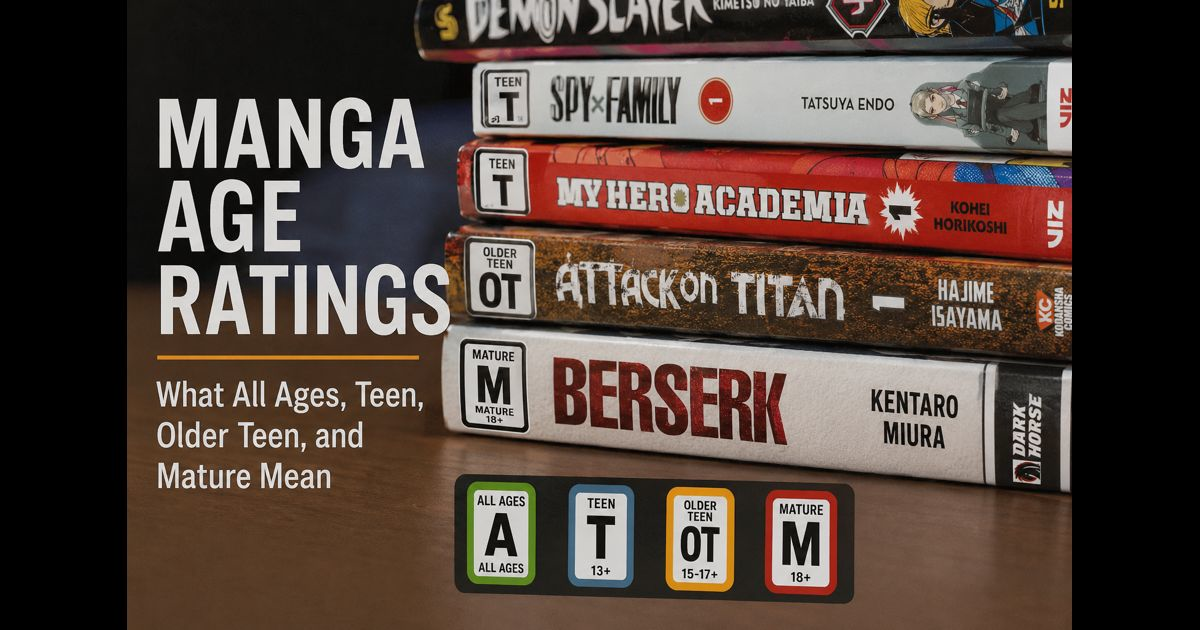
Manga age ratings help readers understand whether a particular book may be suitable for a certain age group. English-language manga commonly uses labels such as All Ages, Teen or 13+, Older Teen or Teen Plus, and Mature or 18+.
There is no single age-rating system followed by every manga publisher. The names, age ranges, and standards can differ, so the rating shown by the publisher of the specific edition is usually the most useful starting point.
Ratings may consider violence, strong language, frightening scenes, substance references, sensitive topics, and other mature themes. They should be used as guidance rather than as a complete description of everything that appears in a book.
Manga Age Ratings at a Glance
|
Common rating |
Typical guidance |
What readers may encounter |
|
All Ages |
General audiences |
Mild action, simple themes, light humor |
|
Youth |
Roughly 8–10+ |
Mild violence, bullying, slightly stronger themes |
|
Teen / T |
Around 13+ |
Action, some blood, stronger language, more serious themes |
|
Older Teen / T+ / OT |
Around 15–17+ |
Stronger violence, disturbing scenes, stronger language, mature themes |
|
Mature / M |
Usually 18+ |
Intense violence, disturbing material, strong language, adult-level themes |
These ranges are only a general comparison. Publishers can use different labels and minimum ages.
There Is No Universal Manga Rating System
Manga published in English does not receive one standard age rating from a single organization.
Publishers can establish their own rating systems. This is why readers may see labels such as:
- All Ages
- Youth
- Teen or 13+
- Older Teen
- Teen Plus or T+
- 15+
- 16+
- 17+
- Mature or 18+
The labels can look similar without having exactly the same definition.
When checking a manga, identify the publisher responsible for the edition and use that publisher's guidance rather than assuming that every 13+, 16+, or 18+ label follows identical rules.
What Does All Ages Mean for Manga?
All Ages generally indicates that a publisher considers a manga suitable for a broad range of readers.
That does not necessarily mean the book was written specifically for small children.
An All Ages manga can still include mild action, fantasy battles, comic danger, emotional moments, or slightly frightening characters. The story itself may also be too complicated for very young readers even when its content is mild.
This makes age suitability and reading difficulty two separate considerations.
Parents choosing manga for younger readers can consider both the publisher's rating and whether the story is appropriate for the child's reading and comprehension level.
What Does Teen or 13+ Mean?
Teen is one of the most frequently seen manga ratings.
A Teen or 13+ manga can contain stronger material than an All Ages title. Depending on the individual book and publisher, this may include action violence, some blood, stronger language, frightening moments, crude humor, substance references, or more serious themes.
Not every Teen manga contains all of these elements.
One book might receive a Teen rating mainly because of its battles, while another may receive the same rating because its themes are more emotionally demanding.
The age number therefore gives useful guidance but does not explain the complete contents of a book.
What Does Older Teen, OT, or T+ Mean?
Older Teen usually sits between an ordinary Teen rating and a Mature rating.
Publishers may use labels such as Older Teen, OT, T+, 15+, 16+, or 17+.
Manga at this level can contain stronger violence, more visible injuries, disturbing scenes, stronger language, substance use, or themes intended for older readers.
This makes the difference between Teen and Older Teen worth checking rather than treating both categories as interchangeable.
Two books with the same age recommendation can also receive it for completely different reasons. Looking at information about the individual title provides a clearer picture than relying on the number alone.
What Does Mature or 18+ Mean?
A Mature or 18+ rating generally indicates that the publisher considers the manga appropriate for adult readers.
A title may receive this classification because of intense violence, disturbing imagery, strong language, substance use, difficult subject matter, or other mature themes.
Mature is not a manga genre.
For example, a serious psychological story and an intense horror manga could both receive a Mature rating even though their stories are completely different.
The rating indicates the general level of the material rather than the type or quality of the manga.
Shonen, Shojo, Seinen, and Josei Are Not Age Ratings
Japanese publishing demographics should not be confused with content ratings.
Labels such as shonen, shojo, seinen, and josei traditionally describe the audience or publishing demographic associated with a manga. They do not work like All Ages, 13+, 16+, or 18+ ratings.
For example, shonen does not automatically mean that every title is suitable for every child. Individual shonen manga can contain intense battles, frightening scenes, or serious themes.
Similarly, seinen should not automatically be interpreted as an 18+ rating. Individual titles can vary considerably.
Demographic, genres, and age ratings provide different information.
|
Classification |
What it describes |
|
Shonen, shojo, seinen, josei |
Intended readership or publishing demographic |
|
Action, romance, fantasy, comedy, horror |
Type of story |
|
All Ages, Teen, Older Teen, Mature |
General content suitability |
The rating of the actual edition is therefore more useful for judging age suitability than its demographic category alone.
What Can Affect a Manga Age Rating?
Publishers can consider several parts of a manga before assigning an age recommendation.
Violence
The amount and intensity of violence can make a difference. Light fantasy action is not the same as prolonged battles showing serious injuries or disturbing scenes.
Language
Occasional mild language may be treated differently from frequent strong language.
Frightening Content
Horror imagery, threatening characters, frightening situations, or psychologically intense scenes can affect suitability even when a manga contains relatively little violence.
Substance References
References to alcohol, tobacco, or drugs may contribute to a higher age recommendation.
Mature Themes
Some stories deal with complicated or sensitive subjects that require greater emotional maturity. A manga can therefore receive a higher rating because of its overall themes even without particularly graphic scenes.
Why Can Manga Ratings Differ Between Publishers?
Publishers make their own editorial judgments about age suitability.
Their systems can be broadly similar while differing in the details. One company might use Teen and Older Teen, while another uses numerical labels such as 13+, 16+, or 18+.
The same type of content can also be assessed slightly differently under separate systems.
This is why comparing only the number on two unrelated manga can sometimes be misleading.
For the clearest guidance, check the standards used by the publisher responsible for the edition being read.
Why Can the Same Manga Have Different Age Recommendations?
Different recommendations do not necessarily mean that one source is incorrect.
The information may refer to different editions, regions, publishers, or volumes. Retailers, libraries, and reading websites can also provide their own recommendations instead of reproducing the publisher's classification exactly.
A long-running series can create another complication because its content may change as the story progresses.
When several age recommendations appear online, check the exact publisher, edition, and volume before comparing them.
Can Later Manga Volumes Have Stronger Content?
Yes. The tone of a manga series can change over time.
A story that begins with relatively light adventures may later introduce more intense battles, frightening events, stronger language, or heavier themes.
Parents and younger readers should therefore avoid assuming that every later volume will contain exactly the same level of material as volume 1.
When suitability is important, checking later volumes individually can provide a more accurate picture.
Where Can You Find a Manga Age Rating?
On printed English-language manga, the rating is commonly found on or around the back cover. Publisher catalogs and official product information may also provide an age recommendation.
Digital manga platforms may display the information in the book description, product details, age guidance, or similar sections.
When different websites provide conflicting recommendations, prioritize information connected to the publisher responsible for the exact edition.
It is also worth checking the volume number, language, and edition to make sure the information refers to the same book.
How Parents Can Check Manga Beyond the Rating
An age label is a useful first filter, but it cannot explain every part of a story.
Parents can make a more informed decision by checking the publisher's rating, identifying the type of content responsible for concern, considering the individual reader's maturity, and reviewing later volumes when a series changes noticeably.
For example, one child may be comfortable with fantasy battles but dislike frightening imagery. Another may find emotionally difficult stories more challenging than action scenes.
The printed age should therefore be considered alongside the individual reader rather than treated as an absolute rule.
Manga Age Ratings and Reading Levels Are Different
An age rating primarily concerns the suitability of the content. It does not necessarily describe how difficult a manga is to read.
An All Ages title can still have complicated storytelling, unfamiliar vocabulary, or concepts that are difficult for a young child.
Likewise, a manga intended for older readers can use relatively straightforward language while dealing with mature or emotionally demanding subjects.
For younger readers, two separate questions are useful:
Is the content suitable?
Can the reader comfortably understand the story?
The answers can be different.
Manga Age Ratings Do Not Measure Quality
A higher age rating does not mean a manga is better, deeper, or more sophisticated.
Likewise, an All Ages rating does not mean a story is simplistic.
Age classifications do not judge artwork, storytelling, originality, cultural value, or writing quality. Their purpose is to provide guidance about content suitability.
Excellent manga can exist across every age category.
Why the Reason Behind a Rating Matters
An age number becomes more useful when readers understand why it was assigned.
Imagine two manga carrying the same Older Teen rating. One may contain intense fantasy battles, while another receives the rating because of frightening themes and strong language.
The age label is identical, but the reading experience can be very different.
When more detailed information is available, consider the publisher's rating together with the specific content of the title and the needs of the individual reader.
Manga Age Ratings FAQ
Are manga age ratings universal?
No. Manga publishers can use different age-rating systems, labels, and standards. Always check the guidance provided for the specific edition.
What age is Teen manga for?
Teen manga is commonly recommended for readers around age 13 and older, although exact minimum ages vary between publishers.
What does T+ mean on manga?
T+ generally means Teen Plus and indicates stronger content than a standard Teen rating. The exact age recommendation depends on the publisher.
What does OT mean on manga?
OT commonly means Older Teen. It normally sits between Teen and Mature, although publishers can define the category differently.
What does M mean on manga?
M generally means Mature and indicates material intended for adult readers. The classification can reflect intense violence, disturbing content, strong language, or other mature themes.
Does shonen mean manga is suitable for children?
No. Shonen is a publishing demographic rather than an age rating. Individual shonen titles can have different content classifications.
Does seinen automatically mean 18+?
No. Seinen describes a publishing demographic rather than a universal age classification. Individual seinen manga can receive different ratings.
Can different volumes have different age guidance?
Yes. A series can introduce stronger or more mature material as its story develops, so later volumes may require separate consideration.
Is All Ages manga always suitable for young children?
Not necessarily. The content may be mild while the story, themes, or reading difficulty are better suited to an older child.
Final Thoughts
Manga age ratings provide useful guidance, but their exact meaning depends on the publisher and edition. All Ages, Teen, Older Teen, Teen Plus, and Mature give readers a quick indication of the general level of content rather than a universal guarantee.
The most important distinction is between age rating, demographic, and genre. Shonen, shojo, seinen, and josei describe publishing demographics, while labels such as 13+, 16+, and 18+ provide guidance about content suitability.
For the clearest assessment, check the rating attached to the exact edition, consider what type of material influenced that rating, and take the individual reader into account. This gives parents, librarians, and readers a more useful picture than relying on an age number alone.