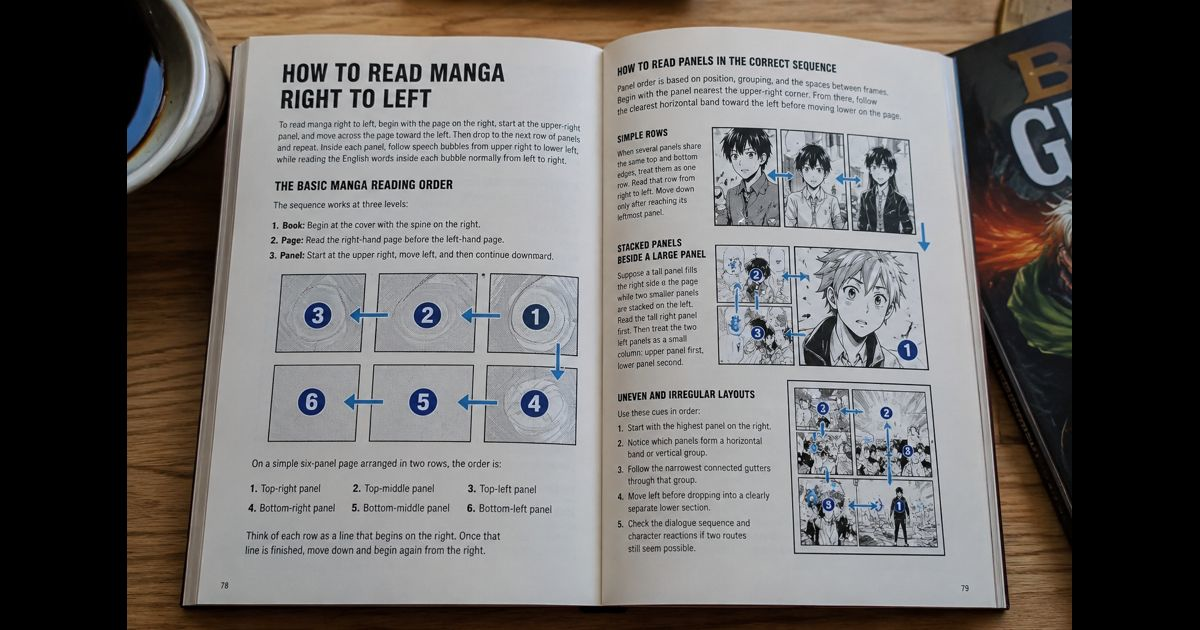
To read manga right to left, begin with the page on the right, start at the upper-right panel, and move across the page toward the left. Then drop to the next row of panels and repeat. Inside each panel, follow speech bubbles from upper right to lower left, while reading the English words inside each bubble normally from left to right.
That rule handles most pages. The only real difficulty comes when panels are different sizes or arranged in overlapping groups. In those cases, the gutters—the blank spaces separating panels—show which panels belong together and where the eye should move next.
The Basic Manga Reading Order
Traditional Japanese manga preserves the page and panel direction of the original edition. The sequence works at three levels:
- Book: Begin at the cover with the spine on the right.
- Page: Read the right-hand page before the left-hand page.
- Panel: Start at the upper right, move left, and then continue downward.
On a simple six-panel page arranged in two rows, the order is:
- Top-right panel
- Top-middle panel
- Top-left panel
- Bottom-right panel
- Bottom-middle panel
- Bottom-left panel
Think of each row as a line that begins on the right. Once that line is finished, move down and begin again from the right.
How to Hold and Open a Physical Manga Volume
A translated manga volume may initially look as if its front and back covers have been reversed. They have not. Hold the book so the spine is on your right and the loose page edges are on your left. The front cover should face you in that position.
Open the book from the left edge. Pages turn from left to right as you progress through the volume. Many English editions place a warning near the opposite end telling readers that they have opened the book from the wrong side.
The page on the right is read before the page on the left whenever both are visible. Finish every panel on the right-hand page before moving across the centre binding to the left-hand page.
How to Read Panels in the Correct Sequence
Panel order is based on position, grouping, and the spaces between frames. Begin with the panel nearest the upper-right corner. From there, follow the clearest horizontal band toward the left before moving lower on the page.
Simple Rows
When several panels share the same top and bottom edges, treat them as one row. Read that row from right to left. Move down only after reaching its leftmost panel.
Stacked Panels Beside a Large Panel
Suppose a tall panel fills the right side of the page while two smaller panels are stacked on the left. Read the tall right panel first. Then treat the two left panels as a small column: upper panel first, lower panel second.
If the tall panel is on the left and the stacked pair is on the right, read the upper-right panel, then the lower-right panel, and then the tall left panel. The surrounding gutters usually make this grouping visible.
Uneven and Irregular Layouts
Some pages use diagonal borders, inset frames, borderless images, or panels of sharply different sizes. Use these cues in order:
- Start with the highest panel on the right.
- Notice which panels form a horizontal band or vertical group.
- Follow the narrowest connected gutters through that group.
- Move left before dropping into a clearly separate lower section.
- Check the dialogue sequence and character reactions if two routes still seem possible.
Panel size does not determine order. A large panel may come before, between, or after several smaller panels. Its position and relationship to surrounding gutters matter more than its area.
Inset and Borderless Panels
An inset panel placed inside or over a larger image is usually read where it appears in the surrounding sequence. A borderless image may serve as a background rather than a separate moment. If it contains its own dialogue or a distinct action, its placement relative to nearby framed panels will normally indicate when it should be read.
How to Read Speech Bubbles and Captions
First establish which panel comes next. Then read the text elements inside that panel from upper right toward lower left.
When two speech bubbles sit at roughly the same height, read the bubble on the right first. When one is clearly above the other, read the upper bubble first. A vertical chain of connected bubbles is normally read from top to bottom.
Remember the important distinction between bubble order and word order:
- Move between translated speech bubbles from right to left.
- Read the English words inside each bubble from left to right.
Speech-bubble tails point toward the speaker. Thought bubbles, narration boxes, and off-panel dialogue follow the same general page flow, although their shapes may differ. A bubble joined to another bubble often represents a pause or a continuing statement; read the joined sections from top to bottom unless their placement clearly directs the eye another way.
If a conversation seems nonsensical, recheck the bubbles before rereading the panels. New readers often choose the correct panel but reverse two dialogue balloons inside it.
Sound Effects, Symbols, and Motion Cues
Manga communicates more than dialogue. Large stylised lettering may represent a crash, footsteps, silence, tension, or even an emotional atmosphere. An English edition may replace the Japanese sound effect, print a small translation beside it, or leave the original lettering intact.
Sound effects belong to the action they touch, so they do not always form a separate reading sequence. Read any supplied translation when you reach that action rather than trying to fit every decorative character into the speech-bubble order.
Motion lines, impact marks, gaze direction, and changes in a character’s expression also help confirm panel flow. A raised fist in one panel followed by an impact in another gives a clear cause-and-effect sequence. These visual clues are especially useful on pages with diagonal or overlapping frames.
Double-Page Spreads and Full-Page Panels
A full-page panel is one continuous moment. Begin near the upper right, take in the composition, and follow any dialogue or captions in their normal right-to-left order.
A double-page spread uses the facing pages as one image. Pause to view the entire composition before following its text and any embedded panels. If the spread contains distinct framed panels, begin on the right-hand page and work toward the left. If it is a single uninterrupted illustration, there may be no meaningful panel sequence beyond the dialogue placement.
Digital editions sometimes split a double-page spread into two separate screens. Landscape or two-page view can restore the intended composition. Make sure the reader pairs the correct pages; an incorrectly paired spread may place unrelated pages beside each other.
Reading Manga Right to Left on a Phone, Tablet, or Computer
Digital manga keeps the artwork’s right-to-left panel flow, but page navigation varies by platform. Some readers use taps, some use horizontal swipes, and others use arrow keys. Do not assume that one gesture works everywhere; follow the on-screen direction or enable a setting labelled right-to-left, manga mode, or page direction when available.
When reading manga online, use single-page view on a small phone so the text remains legible without excessive zooming. On a tablet or wide monitor, two-page view can preserve spreads, provided the app supports right-to-left page pairing. Guided or panel-by-panel view may be helpful, but it can crop artwork or reveal panels in an order chosen by the software rather than the page designer.
If pages seem reversed, check the reader settings before assuming the edition itself is wrong. If dialogue is hard to follow, switch off continuous vertical scrolling and return to full-page view so the original panel relationships are visible.
Not Every Comic Uses the Same Direction
Most Japanese manga editions use right-to-left page and panel order, but the format should be confirmed rather than assumed.
Older English releases were sometimes “flipped” or mirrored to read from left to right. Some contemporary works created outside Japan use manga-influenced art while keeping Western left-to-right layouts. Korean manhwa and Chinese manhua may follow different print conventions, while many digital series use a vertical-scroll format designed for phones.
Check these signals before starting:
- A reading-direction notice near either end of the book
- The position of the front cover and title page
- Page numbers or chapter numbering
- The sequence of speech bubbles in the opening scene
- Direction controls in the digital reader
Do not judge direction from the art style alone. The publisher’s layout and the edition in front of you are what matter.
A Fast Practice Method for Beginners
Use this routine for the first few pages of a new volume:
- Place a finger near the upper-right panel.
- Trace the first row toward the left without reading.
- Drop to the right side of the next row.
- Return to the first panel and read its bubbles from upper right to lower left.
- Pause after each page and summarise the action in one sentence.
If the summary makes sense, the sequence was probably correct. If an answer appears before a question, an impact appears before the movement that caused it, or a character reacts before an event occurs, go back to the last clear panel and try the other grouping.
After a chapter or two, the eye usually begins to recognise the layout without conscious tracing. Speed is not the goal at first. Accurate sequence preserves timing, reveals, humour, and emotional reactions that can be lost when panels are reversed.
Common Mistakes and How to Fix Them
Starting at the Left Edge
Reset your eye at the upper-right corner every time you turn a page. A brief pause is enough to prevent the habits of English prose reading from taking over.
Moving Down Too Early
Finish the current horizontal group before entering a lower row. Use the panel borders and gutters to identify where the group ends.
Reading Every Element Strictly by Height
The highest item is not automatically first if it belongs to a panel farther left. Establish panel order before bubble order.
Following the Largest Panel First
Large panels attract attention but do not automatically begin the page. Look for the upper-right starting point and the surrounding frame structure.
Reversing the English Inside a Bubble
Only the sequence of panels and bubbles runs right to left. Translated English sentences still read from left to right.
Treating Every Page as a Perfect Grid
Artists vary panel shape and spacing to control pace. Read visible groups rather than forcing every page into identical rows.
Frequently Asked Questions
Do you read manga from top right or bottom right?
Begin at the top right. Move left across the upper group of panels, then drop to the next group and begin again from its right side.
Are manga speech bubbles read right to left?
The bubbles are generally followed from upper right to lower left within the current panel. In an English translation, the words inside each bubble are still read from left to right.
Which page comes first when a manga book is open?
The right-hand page comes first. Finish it before moving to the left-hand page.
Why are some manga read left to right?
Some older translations were mirrored for Western readers, and some manga-influenced comics were originally designed for left-to-right reading. A direction notice, title page, page numbers, or opening dialogue can confirm the edition’s layout.
How do you read manga when the panels are uneven?
Start at the upper right, identify panels grouped by aligned edges and narrow gutters, finish that group toward the left, and then move downward. Dialogue and cause-and-effect action can confirm the intended order.
Is manga read differently on a phone?
The panel and speech-bubble order stays the same, but the gesture used to change pages depends on the app. Enable right-to-left or manga mode when offered, and use full-page view whenever guided view makes the layout unclear.
Final Thoughts
Reading manga right to left becomes simple once the three layers are separated: right-hand page before left-hand page, upper-right panel toward lower left, and upper-right speech bubble toward lower left within each panel. English text inside translated bubbles still reads normally from left to right.
On complex pages, gutters, panel groups, dialogue, and cause-and-effect action provide the route. Follow those signals instead of panel size, and the artist’s pacing will soon feel natural.