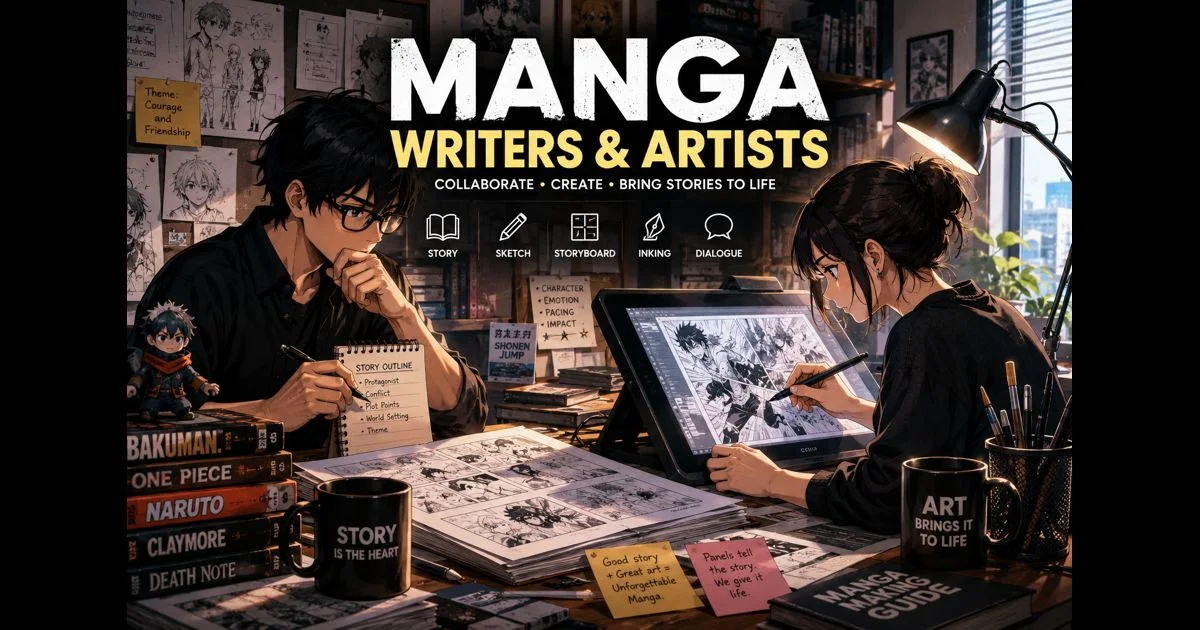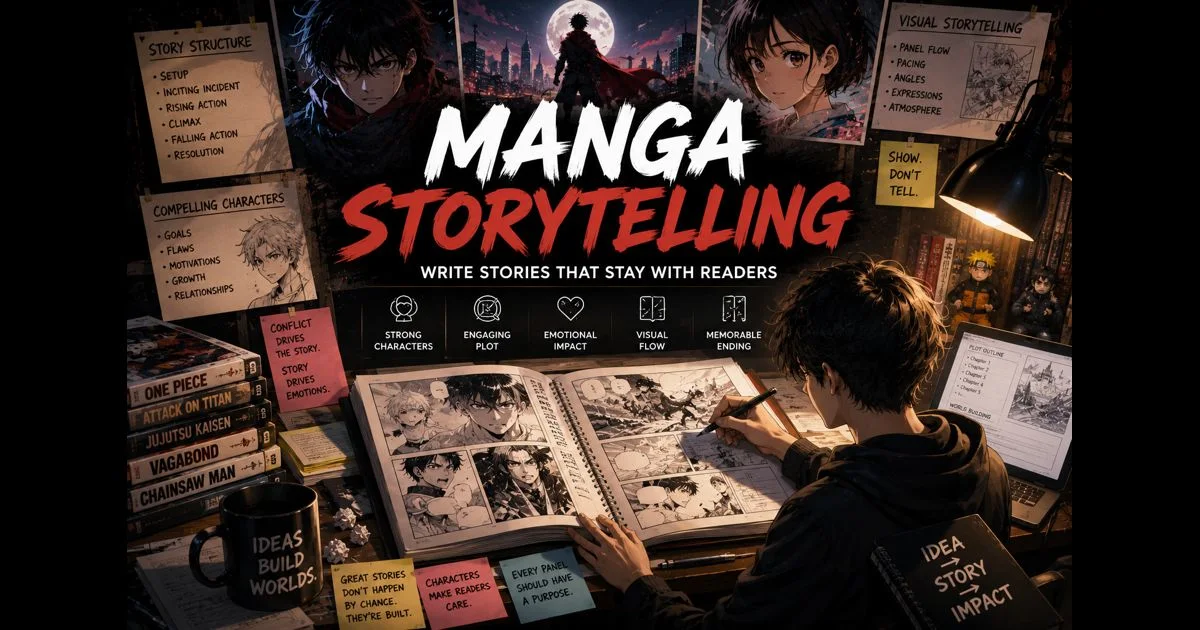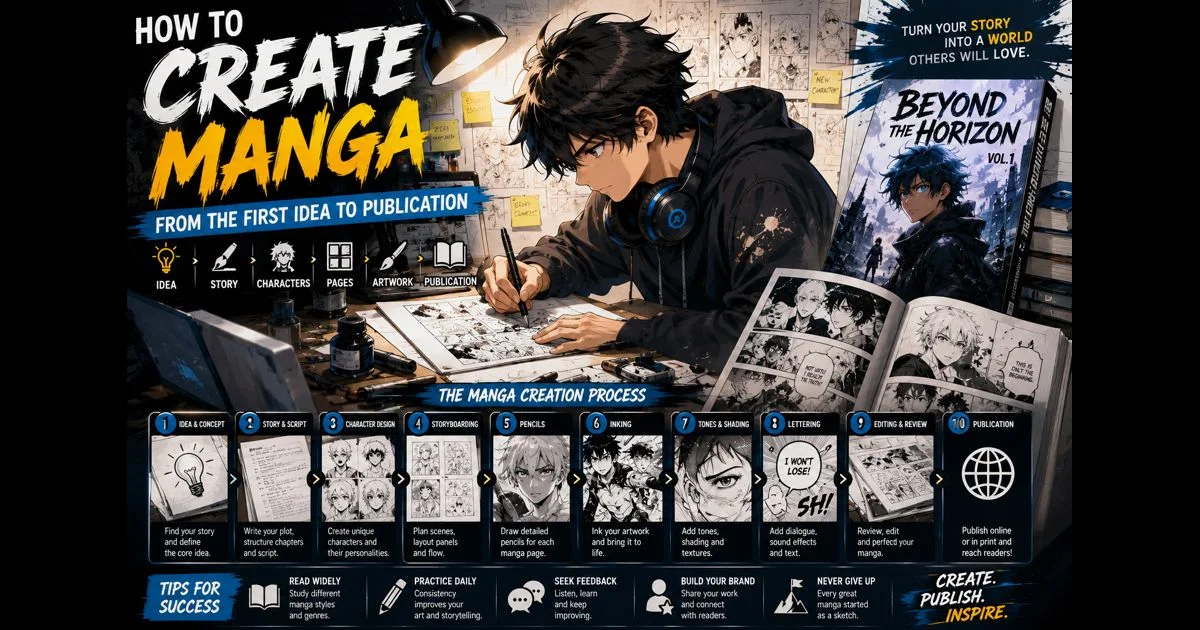
Creating manga is not simply a matter of drawing attractive characters or writing an exciting plot. It is a complete creative process that combines storytelling, visual direction, character development, page composition, technical production, and publishing strategy.
Every finished manga begins with a simple idea. That idea is gradually shaped into a clear premise, a believable cast, a structured story, and a sequence of pages designed to guide the reader from one moment to the next. The process may look different for a solo creator, a professional studio, or a web-first artist, but the essential stages remain largely the same.
A creator usually moves through concept development, research, scripting, storyboarding, character design, page layouts, illustration, editing, lettering, and final production. Some projects are completed traditionally with pencils, ink, paper, and screentones. Others are produced entirely through digital software. Many artists combine both methods.
This guide explains how manga is developed from its earliest concept to a finished work ready for readers. It also covers sustainable production, creative decision-making, publishing routes, audience building, and the practical challenges creators face along the way.
Understanding the Modern Manga Industry
Manga has developed from a major Japanese publishing tradition into a global form of visual storytelling. Readers now discover manga through printed volumes, serialized magazines, licensed reading apps, digital storefronts, web platforms, subscription services, and independent creator communities.
Traditional manga publishing remains highly influential. Large publishers often work closely with creators through editors who help refine concepts, improve chapter pacing, evaluate reader response, and maintain production schedules. Successful serialized works may later be collected into volumes and adapted into animation, films, games, merchandise, or other media.
At the same time, independent publishing has created new opportunities. Artists can release short manga online, build an audience through social platforms, fund printed editions through crowdfunding, or publish directly through digital marketplaces. This allows creators to test ideas without waiting for approval from a major publisher.
The wider industry now includes several important areas:
- Traditional magazine serialization
- Printed manga volumes
- Licensed international editions
- Digital chapter releases
- Mobile-first reading platforms
- Web manga and webcomics
- Independent print publishing
- Crowdfunded editions
- Print-on-demand distribution
- Convention and artist-alley sales
Understanding these options early helps a creator make better decisions about page size, reading direction, chapter length, artwork detail, release frequency, and long-term rights.
Traditional Manga Publishing
In a traditional publishing model, a creator usually submits a one-shot, sample chapter, storyboard, or pitch package to an editor, competition, or publisher. The editor evaluates the idea, storytelling quality, visual skill, target audience, and whether the project fits the publisher’s current needs.
If the project moves forward, the editor becomes an important creative partner. Editors may suggest changes to character motivations, opening chapters, dialogue, cliffhangers, scene order, or visual clarity. They also help creators work within deadlines and prepare material for publication.
Traditional publishing can offer several advantages:
- Professional editorial guidance
- Established distribution
- Printing and production support
- Access to bookstores and licensed markets
- Greater industry visibility
- Potential adaptation opportunities
However, it may also require strict deadlines, significant revisions, shared decision-making, and less control over certain commercial elements.
Independent and Digital Publishing
Independent publishing gives creators more authority over the story, schedule, format, artwork, branding, and business decisions. A creator may publish one chapter at a time, release complete volumes, sell digital downloads, or create limited printed editions.
This route can be more flexible, but the creator must often manage several roles at once. These may include:
- Writer
- Illustrator
- Editor
- Letterer
- Production manager
- Social media manager
- Marketer
- Distributor
- Customer support contact
Digital publishing also allows creators to study reader behavior more directly. Chapter completion rates, comments, follows, saves, and subscriber growth can reveal which characters, scenes, or story arcs are connecting with the audience.
The main challenge is balancing creative work with promotion and administration. Without a sustainable system, marketing tasks can easily reduce the time available for drawing and writing.
Defining the Core Manga Concept
A strong manga project begins with a clear central idea. The concept should explain what the story is about, who the main character is, what they want, and what stands in their way.
Many weak projects begin with a collection of characters or dramatic scenes but lack a focused narrative direction. A clear premise prevents the story from becoming disconnected or unnecessarily complicated.
Start by answering four basic questions:
- Who is the main character?
- What do they want?
- What prevents them from getting it?
- What makes this story visually or emotionally distinctive?
The answers do not need to be complex. In fact, a simple concept with strong execution is often more effective than an ambitious idea with no clear structure.
Writing a One-Sentence Logline
A logline is a short sentence that summarizes the main story. It acts as a creative filter throughout development.
A useful logline usually includes:
- The protagonist
- The main goal
- The central obstacle
- The distinctive situation
For example:
A quiet apprentice chef must win a dangerous culinary tournament to save the floating restaurant where she was raised.
This sentence immediately suggests a protagonist, conflict, setting, emotional stake, and visual identity.
A clear logline also makes it easier to explain the manga to editors, collaborators, readers, or potential supporters.
Choosing the Genre and Intended Audience
Genre influences reader expectations. Action readers may expect escalating challenges, clear rivalries, and memorable confrontations. Romance readers may focus more on emotional tension, chemistry, vulnerability, and relationship development. Mystery readers usually expect clues, uncertainty, and satisfying reveals.
A manga may combine several genres, but one or two should remain dominant.
Possible directions include:
- Action
- Adventure
- Romance
- Fantasy
- Horror
- Mystery
- Comedy
- Science fiction
- Sports
- Historical drama
- Slice of life
- Psychological drama
The intended audience also affects tone, pacing, dialogue, subject matter, and visual presentation. Traditional labels such as shonen, shojo, seinen, and josei can offer useful creative context, but they should not limit originality.
The most important goal is to understand what kind of emotional experience the manga promises its readers.
Identifying the Story’s Central Theme
Theme gives a manga deeper meaning beyond its surface plot. A story may be about a tournament, a school, a war, or a supernatural mystery, but its theme may concern loyalty, grief, ambition, identity, responsibility, or forgiveness.
Strong themes are explored through character decisions rather than explained through long speeches.
For example, a story about freedom becomes more powerful when different characters define freedom differently. One character may see it as independence, another as escape, and another as the ability to protect others.
A useful exercise is to complete this sentence:
This story explores what happens when…
The answer can help reveal the emotional core of the project.
Researching the World of the Manga
Research gives fictional worlds weight and credibility. Even highly imaginative manga often depend on real references for clothing, architecture, weapons, transportation, social customs, landscapes, food, or professional routines.
The goal is not to include every fact discovered during research. It is to select details that make scenes feel convincing.
Building a Visual Reference Library
Create organized reference folders before detailed drawing begins. These may include:
- Character clothing
- Hairstyles
- Interior spaces
- Buildings
- Landscapes
- Vehicles
- Tools
- Historical objects
- Lighting conditions
- Body poses
- Facial expressions
- Cultural references
Visual references reduce guesswork and improve consistency. They are especially useful when drawing repeated environments such as classrooms, apartments, shops, offices, or battle locations.
References should support original design rather than encourage direct copying. Combine multiple sources and adapt details to fit the project’s setting and artistic style.
Researching Real Professions and Activities
When a character has a specialized role, basic research can prevent obvious mistakes.
A manga about chefs, musicians, athletes, lawyers, doctors, mechanics, investigators, or craftspeople becomes more believable when the creator understands how those people move, speak, prepare, and solve problems.
Small authentic details often matter more than large explanations. The way a baker holds a tool, how a runner prepares before a race, or how a stage crew communicates during a performance can make a scene feel lived-in.
Knowing When to Stop Researching
Research can become a form of procrastination. A creator may spend weeks gathering information without writing or drawing a single page.
Set a practical research limit before production begins. Gather enough information to write the first arc, then continue researching only when the story requires it.
The purpose of research is to support the manga, not delay it.
Building Memorable Manga Characters
Characters are often the strongest reason readers continue a series. A visually impressive world may attract attention, but believable personalities, emotional conflicts, and evolving relationships create long-term engagement.
Each major character should have a clear desire, internal weakness, personal history, and way of interpreting the world.
Defining Wants, Needs, and Inner Conflict
A character’s want is what they consciously pursue. Their need is the emotional lesson or change they may not yet understand.
For example:
- A character wants recognition but needs self-respect.
- A character wants revenge but needs to release guilt.
- A character wants independence but needs to learn trust.
- A character wants victory but needs to accept responsibility.
This gap between want and need creates internal conflict.
The plot should place the character in situations where avoiding change becomes increasingly difficult.
Creating Distinct Character Voices
Dialogue should sound different from one character to another. Vocabulary, sentence length, humor, hesitation, confidence, and silence all contribute to voice.
One character may speak directly and rarely explain themselves. Another may overtalk when nervous. A third may answer serious questions with jokes.
A useful test is to remove the speaker names from a conversation. The dialogue should still provide clues about who is speaking.
Distinct voices make group scenes easier to follow and help readers form stronger connections with the cast.
Designing Relationships That Create Story
Characters become more interesting through relationships. A strong cast should not feel like isolated individuals waiting for their turn to speak.
Create a relationship map that identifies:
- Friends
- Rivals
- Mentors
- Siblings
- Enemies
- Secret allies
- Former partners
- Unbalanced relationships
- Conflicting loyalties
Each relationship should create tension, support, misunderstanding, change, or emotional consequence.
The strongest character dynamics often combine several roles at once. A mentor may also be a rival. A friend may hide resentment. An enemy may understand the protagonist better than anyone else.
Designing the Manga’s Setting and World
A setting should do more than provide a background. It should affect what characters can do, what they fear, what they value, and how conflicts unfold.
A strong setting creates story pressure.
For example, a city divided by rising water levels changes transportation, housing, class structure, politics, and everyday routines. A school built inside a moving fortress affects schedules, relationships, safety, and visual composition.
Connecting Setting to Conflict
The environment should create obstacles and opportunities.
Ask:
- What is dangerous about this place?
- What does this setting allow that another would not?
- How does the environment shape daily life?
- What resources are limited?
- What rules control the characters?
- What visual features make the location recognizable?
When the setting influences decisions, it becomes an active part of the narrative.
Avoiding Unnecessary Worldbuilding
Detailed worldbuilding can strengthen a story, but too much explanation can overwhelm readers.
Avoid presenting the world through long information blocks unless the information is immediately relevant. Reveal details through action, dialogue, visual symbols, routine, and conflict.
Readers usually understand a world more naturally by seeing characters live within it.
The creator may know the full history of a kingdom, school, organization, or supernatural system, but the reader only needs the information required to understand the current scene.
Scriptwriting: Turning Ideas into a Readable Story
Once the concept, characters, and world are established, the next stage is transforming those ideas into a structured script. A well-written script provides direction for every page, ensuring that each scene moves the story forward while keeping readers emotionally invested.
Unlike a novel, manga scripts are written with visual storytelling in mind. Every conversation, action, and emotional beat should eventually become a panel, making clarity more important than excessive description.
Before writing individual chapters, identify the overall direction of the story. Even if details change later, having a roadmap prevents unnecessary detours and keeps character development consistent.
Planning the Main Story Arc
A long-running manga should have an overarching storyline that connects multiple chapters or volumes.
Ask yourself:
- Where does the protagonist begin?
- What major obstacle changes their life?
- What challenges force them to grow?
- What is the emotional climax?
- How will the journey end?
Knowing the destination helps every chapter contribute to the larger narrative instead of feeling disconnected.
Breaking the Story into Smaller Arcs
Large stories become easier to manage when divided into smaller arcs.
Each arc should introduce its own objective, conflict, climax, and resolution while still moving the overall story forward.
For example:
- Introduction Arc
- Training Arc
- Tournament Arc
- Investigation Arc
- Rescue Arc
- Final Confrontation Arc
Readers enjoy completing milestones, making shorter arcs feel rewarding even within a much larger series.
Writing Chapters That Keep Readers Turning Pages
Every chapter should provide progress.
Instead of filling pages with repeated conversations or unnecessary exposition, ensure every chapter answers one important question while creating another.
A simple chapter structure often includes:
- Opening hook
- Rising conflict
- Character decision
- Unexpected complication
- Cliffhanger or emotional payoff
This rhythm encourages readers to continue immediately into the next chapter.
Writing Strong Manga Scenes
Scenes are the building blocks of every manga chapter. Each one should have a clear purpose.
Ask before writing:
- What changes during this scene?
- Who wants something?
- What stands in their way?
- How will readers feel afterward?
If nothing changes by the end of the scene, it may not be necessary.
Balancing Dialogue and Visual Storytelling
Manga is primarily a visual medium.
Readers should understand much of the story through expressions, body language, environments, and actions instead of lengthy conversations.
Avoid explaining emotions that can already be seen.
Instead of writing:
“I’m nervous about tomorrow.”
Show:
- shaking hands
- avoiding eye contact
- unfinished meals
- restless pacing
- hesitant speech
Visual storytelling allows readers to experience emotions instead of simply reading about them.
Writing Natural Dialogue
Good dialogue sounds like real people speaking rather than characters delivering information.
Keep dialogue:
- Clear
- Purposeful
- Distinctive
- Emotionally believable
Avoid making every character speak with the same vocabulary or sentence structure.
Each character should have recognizable speech patterns that reflect their personality, background, confidence, and emotional state.
Controlling Story Pacing
Pacing determines how quickly readers move through emotional and narrative moments.
Fast pacing works well for:
- Action
- Comedy
- Chases
- Escapes
- Battles
Slower pacing benefits:
- Emotional conversations
- Relationship development
- Mystery
- Reflection
- Worldbuilding
Alternating between high-energy and quieter moments creates a more satisfying reading experience than maintaining constant intensity.
Storyboarding: Designing the Reader’s Experience
Once the script is complete, creators begin storyboarding.
Often called a “name” in Japan, a storyboard is a rough visual draft that maps every page before final artwork begins.
Storyboards save enormous amounts of time because changing rough sketches is much easier than redrawing finished illustrations.
At this stage, focus on storytelling—not polished artwork.
Planning Each Page
Every page should have a clear purpose.
Consider:
- What information appears first?
- Where does the reader’s eye move?
- Which moment deserves the largest panel?
- What should remain hidden until the page turn?
A successful page naturally guides readers without causing confusion.
Creating Effective Panel Flow
Panel arrangement controls reading speed.
Large panels slow readers down, encouraging them to absorb important emotional moments.
Smaller panels create urgency and increase momentum during action sequences.
When arranging panels:
- Avoid clutter.
- Maintain a clear reading order.
- Leave enough space between panels.
- Let important scenes breathe.
Good panel flow becomes invisible because readers instinctively know where to look next.
Using Camera Angles to Tell the Story
Think like a film director.
Changing camera angles creates emotional variety.
Common shot types include:
- Wide establishing shots
- Medium conversation shots
- Close-up reactions
- Extreme close-ups
- Bird’s-eye views
- Low-angle perspectives
- Over-the-shoulder shots
Avoid repeating identical camera positions for long conversations.
Changing perspective keeps pages visually engaging.
Making Every Page Turn Matter
Page turns are one of manga’s greatest storytelling tools.
Readers cannot see the next page until they physically turn it.
Use this to reveal:
- Plot twists
- Character entrances
- Major attacks
- Emotional confessions
- Unexpected discoveries
- Dramatic scenery
Building anticipation before a page turn creates excitement that digital scrolling often cannot replicate.
Creating a Sustainable Manga Workflow
Many new creators focus entirely on finishing one chapter while overlooking how difficult it is to maintain production over months or even years.
A sustainable workflow prevents burnout and improves consistency.
Instead of treating every chapter as a completely different project, develop a repeatable system.
A typical workflow might include:
- Story planning
- Scriptwriting
- Storyboarding
- Sketching
- Line art
- Backgrounds
- Screentones
- Lettering
- Editing
- Final export
Following the same sequence each time reduces decision fatigue and makes long-term production more manageable.
Organizing Production Efficiently
Batch similar tasks whenever possible.
For example:
- Sketch several pages before inking.
- Complete all backgrounds together.
- Finish lettering in one session.
- Export every page after final quality checks.
Working in batches often improves consistency while reducing unnecessary interruptions.
Managing Creative Blocks
Every creator eventually experiences periods where ideas or motivation become difficult.
Rather than waiting for inspiration, change the type of work you’re doing.
If writing feels difficult:
- Design new characters.
- Build environments.
- Gather references.
- Practice anatomy.
- Plan future chapters.
Small productive tasks maintain momentum until creative energy returns.
Building Long-Term Consistency
Readers appreciate reliability.
Publishing one chapter every month for years generally creates stronger audience trust than releasing several chapters quickly before disappearing for extended periods.
Choose a production schedule you can realistically maintain.
Consistency builds confidence, improves artistic skill, and allows both the creator and the audience to enjoy steady progress over time.
Character Design: Creating Memorable and Recognizable Characters
Strong character design goes far beyond attractive artwork. Readers should be able to recognize important characters instantly through their silhouette, posture, facial expressions, clothing, and body language—even before they speak.
Every design choice should communicate personality, background, and purpose.
Ask yourself:
- What is this character’s role?
- What emotion should readers feel when they first appear?
- How has their life shaped their appearance?
- Which visual details make them unforgettable?
A memorable design supports storytelling rather than distracting from it.
Designing Distinctive Silhouettes
A recognizable silhouette helps readers identify characters immediately.
Experiment with different:
- Heights
- Body proportions
- Hairstyles
- Accessories
- Clothing shapes
- Standing poses
If every character shares a similar build and hairstyle, action scenes become harder to follow.
Before adding details, check whether each character remains recognizable as a simple black silhouette.
Using Clothing to Tell a Story
Costumes should reflect personality instead of serving only as decoration.
Consider:
- Occupation
- Social status
- Lifestyle
- Climate
- Culture
- Personal habits
Small details often communicate more than complicated designs.
Examples include:
- Worn-out shoes
- Scratched armor
- Carefully maintained uniforms
- Handmade jewelry
- Weathered backpacks
- Ink-stained sleeves
These visual elements quietly reveal information without requiring dialogue.
Maintaining Design Consistency
As a series grows, consistency becomes increasingly important.
Prepare reference sheets that include:
- Front view
- Side view
- Back view
- Facial expressions
- Hairstyles
- Color references
- Accessories
- Height comparisons
Keeping organized references saves time and prevents noticeable changes between chapters.
Choosing an Art Style That Supports the Story
An effective art style is one you can reproduce consistently while strengthening the story’s atmosphere.
Highly detailed artwork may look impressive, but if it slows production dramatically, maintaining regular updates becomes difficult.
Choose a style that balances quality with efficiency.
Matching Visual Style to Genre
Different genres benefit from different artistic approaches.
Action stories often emphasize:
- Bold line work
- Dynamic poses
- Strong contrast
- Dramatic speed effects
Romance frequently focuses on:
- Soft expressions
- Elegant compositions
- Delicate textures
- Emotional close-ups
Horror may rely on:
- Heavy shadows
- Uneven textures
- Distorted perspectives
- Suspenseful page layouts
Rather than copying existing artists, study why certain visual techniques support specific emotions.
Developing Your Own Artistic Identity
Every successful mangaka eventually develops a recognizable visual voice.
Instead of combining random influences, identify the aspects you naturally enjoy drawing.
Ask yourself:
- Which facial expressions feel most expressive?
- Which environments excite you?
- What kind of action scenes come naturally?
- Which line quality feels comfortable?
Over time, repeated creative decisions gradually shape a unique artistic identity.
Illustration and Page Layout
Once storyboards are approved, creators begin producing finished artwork.
This stage combines clean sketches, line art, backgrounds, screentones, effects, and dialogue into complete pages ready for publication.
While technical skill matters, readability should always remain the highest priority.
Creating Dynamic Panel Layouts
Panels influence how readers experience time.
Large panels encourage readers to pause.
Small panels increase speed.
Irregular layouts can create tension, while balanced compositions provide moments of calm.
Avoid filling every page with identical panel sizes.
Instead, vary layouts according to the emotional intensity of each scene.
Guiding the Reader’s Eye
Every page should naturally direct readers toward the next panel.
Use visual elements such as:
- Character movement
- Eye direction
- Speech balloon placement
- Lighting
- Background perspective
- Motion lines
When these elements work together, readers rarely become confused.
Using Negative Space Effectively
Empty space is an important storytelling tool.
Leaving portions of a panel uncluttered can emphasize:
- Loneliness
- Silence
- Shock
- Reflection
- Emotional distance
Not every page needs dense artwork.
Strategic simplicity often creates stronger emotional impact than excessive detail.
Drawing Expressive Backgrounds
Backgrounds should support the narrative instead of existing purely for decoration.
A carefully designed environment can reveal information about characters, reinforce mood, and strengthen worldbuilding.
Think beyond buildings and landscapes.
Small environmental details can communicate personality.
For example:
- Untidy bedrooms
- Organized workspaces
- Broken furniture
- Family photographs
- Weathered streets
- Crowded marketplaces
These details quietly enrich the story without interrupting its flow.
Knowing When to Simplify Backgrounds
Detailed backgrounds are valuable, but not every panel requires them.
During emotional conversations or intense action, reducing background complexity helps readers focus on character expressions and movement.
Reserve highly detailed scenery for:
- Opening pages
- New locations
- Dramatic reveals
- Important establishing shots
This balance keeps production efficient while maintaining visual impact.
Lettering and Dialogue Placement
Lettering should feel like part of the artwork rather than something added afterward.
Poorly placed dialogue can hide important illustrations or interrupt panel flow.
Plan speech balloons during the storyboard stage whenever possible.
Creating Readable Dialogue
Readers should absorb dialogue quickly without struggling to follow conversations.
Good lettering follows several principles:
- Keep sentences concise.
- Leave comfortable spacing.
- Avoid oversized speech balloons.
- Maintain consistent fonts.
- Place balloons in reading order.
If dialogue dominates the artwork, consider whether some information can instead be communicated visually.
Using Sound Effects Purposefully
Sound effects contribute rhythm and atmosphere.
Rather than adding effects everywhere, use them where they strengthen the action or emotion.
Examples include:
- Explosions
- Footsteps
- Rain
- Wind
- Heartbeats
- Door movements
- Mechanical sounds
Integrating sound effects naturally into the artwork creates a more immersive reading experience.
Editing and Revising Your Manga
Professional-quality manga rarely appears perfect after the first draft.
Editing improves storytelling, artwork, pacing, and readability before publication.
Treat revisions as part of the creative process rather than evidence of failure.
Reviewing Story Structure
Before finalizing a chapter, ask:
- Does every scene move the story forward?
- Are character motivations clear?
- Does the pacing feel balanced?
- Is the ending satisfying?
- Does the chapter encourage readers to continue?
Removing unnecessary scenes often strengthens the overall narrative.
Technical Quality Checks
Perform a final review before exporting files.
Look for:
- Anatomy inconsistencies
- Perspective errors
- Missing backgrounds
- Uneven line weights
- Overlapping speech balloons
- Typographical mistakes
- Cropped artwork
- Incorrect page order
Small technical improvements create a much more polished reading experience.
Learning from Feedback
Constructive criticism helps creators improve more quickly.
Seek opinions from:
- Fellow artists
- Writers
- Editors
- Beta readers
- Members of your target audience
Pay attention to recurring feedback.
If several readers become confused by the same scene, the issue usually deserves attention.
Strong creators remain open to refinement while preserving the core vision of their story.
Publishing Your Manga
Completing a manga chapter is a major milestone, but publishing is what transforms a personal project into a work that readers can discover, enjoy, and support. Whether you pursue a traditional publisher or release your work independently, preparing your manga professionally increases the chances of building a lasting audience.
Each publishing route offers different opportunities, responsibilities, and levels of creative control. The right choice depends on your goals, production schedule, available resources, and the relationship you want to build with readers.
Traditional Publishing
Traditional publishing remains an established route for creators seeking editorial guidance, professional production support, recognized distribution, and wider industry exposure.
Publishers commonly evaluate:
- Originality of the story
- Strength of the characters
- Artistic consistency
- Visual storytelling quality
- Audience suitability
- Ability to meet production expectations
Many creators begin by submitting a polished one-shot, sample chapter, storyboard, or complete pitch package before proposing a longer series.
Traditional publishing may provide:
- Professional editorial feedback
- Print and digital distribution
- Production support
- Marketing assistance
- Greater industry visibility
- Potential licensing and adaptation opportunities
Creators should also be prepared for structured deadlines, requested revisions, collaborative decisions, and specific publishing requirements.
Independent Publishing
Independent publishing gives creators greater control over ownership, format, schedule, pricing, branding, and creative direction.
Creators can release manga through:
- Personal websites
- Digital comic platforms
- Online marketplaces
- Print-on-demand services
- Crowdfunding campaigns
- Conventions and artist alleys
- Direct digital downloads
- Subscription-based communities
This route offers flexibility, but it also requires the creator to manage responsibilities beyond writing and drawing.
These may include:
- File preparation
- Promotion
- Customer communication
- Printing
- Order management
- Financial tracking
- Platform administration
Independent publishing works best when creative production and business tasks are organized separately.
Preparing a Professional Manga Submission
A strong submission should make it easy for an editor or publisher to understand the project quickly.
A complete pitch package may include:
- A concise story summary
- A one-sentence logline
- Main character profiles
- Character design sheets
- A series overview
- Planned story arcs
- Target readership
- A finished one-shot or sample chapter
- Clean storyboard pages
- Creator biography and contact details
Follow each publisher’s submission instructions carefully. Page limits, file formats, language requirements, and submission windows may differ.
Avoid sending unfinished or poorly organized material. A smaller, polished sample usually creates a stronger impression than a large package containing inconsistent work.
Preparing Files for Publication
Before publishing a chapter, review every page carefully.
Check:
- Correct page order
- Consistent margins
- Suitable image resolution
- Readable lettering
- Accurate spelling
- Balanced contrast
- Clean panel borders
- Proper export settings
- Cover artwork
- Chapter title pages
- Backup copies
Test the final chapter in the same format readers will use. A page that looks clear on a large monitor may become difficult to read on a phone.
Digital Distribution and Reader Accessibility
Digital publishing has expanded the opportunities available to manga creators. Readers can now discover original series through mobile apps, websites, online stores, subscriptions, newsletters, and creator-supported platforms.
A digital release should be designed around readability rather than simply uploading print files without adjustment.
Optimizing Manga for Digital Reading
Readers use smartphones, tablets, laptops, and desktop screens, so digital pages should remain clear across different display sizes.
Consider:
- Readable text size
- Clear speech balloons
- Moderate file sizes
- Fast-loading pages
- Consistent page dimensions
- Strong contrast
- Uncluttered panels
- Easy navigation between chapters
Always preview completed pages on more than one device before publishing.
Adapting Manga for Different Formats
Traditional page-based manga and vertical-scroll comics use different pacing systems.
Page-based manga relies heavily on:
- Page turns
- Double-page spreads
- Fixed panel composition
- Right-to-left or left-to-right reading order
Vertical formats often rely on:
- Longer pauses between panels
- Controlled scrolling distance
- Larger text
- Fewer panels visible at once
- Phone-friendly compositions
Creators planning to publish in multiple formats should prepare layered master files that can be rearranged without rebuilding every page.
Preparing for Translation and Localization
A manga may reach readers beyond its original language. Preparing files properly makes future translation easier.
Keep:
- Dialogue on separate layers
- Sound effects separated where possible
- Editable text files
- Character and location name guides
- Notes explaining cultural references
- Consistent terminology across chapters
Avoid placing essential text directly over complex artwork unless it can be edited later.
Localization should preserve the meaning, tone, humor, and emotional intent of the original work rather than replacing dialogue word for word without context.
Marketing Your Manga
Even a well-made manga can remain unnoticed without a clear discovery strategy. Marketing does not require constant promotion. It requires presenting the project consistently to readers who are most likely to enjoy it.
The goal is not to appear everywhere. It is to build recognition in a few relevant places.
Creating a Clear Manga Identity
Readers should quickly understand:
- What the manga is about
- Who the main characters are
- Which genre it belongs to
- What makes it different
- Where they can read it
- When new chapters are released
Use consistent cover design, typography, character imagery, series descriptions, and profile visuals across publishing and social platforms.
Sharing the Creative Process
Readers often enjoy seeing how a manga is made.
Useful behind-the-scenes content includes:
- Character sketches
- Thumbnail comparisons
- Script-to-panel transformations
- Background drawing processes
- Expression sheets
- Inking clips
- Cover development
- Before-and-after revisions
- Production desk setups
This content builds anticipation while allowing readers to connect with the creator’s process.
Creating a Manga Landing Page
A simple landing page gives readers one reliable destination for all essential information.
It may include:
- Series title
- Cover image
- Short synopsis
- Genre
- Creator introduction
- Reading links
- Chapter list
- Release schedule
- Newsletter signup
- Support options
- Social links
Keep the page focused. Readers should not have to search through unrelated information to find the first chapter.
Building a Loyal Reader Community
A smaller group of returning readers is often more valuable than a temporary spike in views.
Build loyalty by:
- Publishing consistently
- Responding to thoughtful comments
- Sharing realistic progress updates
- Thanking readers for support
- Offering previews without spoiling major scenes
- Asking meaningful questions about the series
- Creating accessible spaces for discussion
Community building should support the creative process rather than consume all production time.
Measuring Meaningful Growth
Total views do not always show whether a manga is building a real audience.
Useful performance indicators include:
- Returning readers
- Chapter completion rate
- Saves and follows
- Newsletter subscribers
- Reader comments
- Direct sales
- Supporter retention
- Clicks from promotional posts
- Growth between chapter releases
Use these insights to improve presentation, publishing frequency, chapter openings, covers, and promotional content.
Protecting Your Manga and Creative Rights
Original manga artwork, scripts, characters, and worldbuilding represent valuable creative property. Good documentation and file management help establish ownership and reduce avoidable disputes.
Keeping Clear Creation Records
Maintain dated copies of:
- Story outlines
- Scripts
- Character designs
- Storyboards
- Draft pages
- Final artwork
- Cover concepts
- Publication files
- Collaboration agreements
Organized records provide a clear history of how the project developed.
Backing Up the Project
Never store an entire manga project in only one location.
Use a combination of:
- Main computer storage
- External storage
- Cloud backup
- Secondary offline copies
Back up frequently, especially after completing major production stages.
Use clear file names and version numbers so older drafts can be recovered without confusion.
Working with Collaborators
When working with writers, assistants, editors, letterers, designers, translators, or marketers, clarify responsibilities before production begins.
Discuss:
- Payment
- Deadlines
- Ownership
- Credits
- Revision limits
- File access
- Usage rights
- Confidentiality
- Publication rights
- Revenue sharing
Written agreements are safer than relying on informal expectations.
Building a Sustainable Manga Career
A long-term manga career depends on more than completing one successful chapter. Creators must balance artistic growth, production speed, health, audience expectations, and financial realities.
Improving One Skill at a Time
Trying to master every area simultaneously can become overwhelming.
Focus on targeted improvement, such as:
- Stronger facial expressions
- Cleaner action poses
- Better dialogue
- More readable panel flow
- Faster background production
- Improved perspective
- More consistent lettering
Apply each improvement directly to a real chapter rather than practicing endlessly without finishing projects.
Managing Workload and Burnout
Unrealistic schedules can damage both quality and motivation.
Create a workflow that includes:
- Production days
- Revision time
- Buffer periods
- Rest days
- Backup content
- Realistic chapter lengths
Reduce unnecessary detail in low-priority panels and reserve extra effort for emotionally or visually important moments.
Sustainable production is more valuable than an impressive schedule that cannot be maintained.
Building a Professional Portfolio
A focused manga portfolio should demonstrate storytelling ability, not only illustration skill.
Include:
- One complete short manga
- Sample sequential pages
- Character expressions
- Environment drawings
- Action scenes
- Quiet dialogue scenes
- Storyboards
- Finished pages
- Cover artwork
- Short project descriptions
Show that you can maintain consistency across multiple pages and complete a narrative from beginning to end.
Future Developments in Manga Creation
New tools and reading formats continue to change how manga is produced and distributed. However, technology remains most useful when it supports storytelling rather than replacing creative judgment.
Flexible Digital Production
Modern manga workflows may use:
- Custom brush libraries
- Perspective rulers
- 3D environment references
- Reusable background assets
- Automated panel tools
- Digital screentones
- Cloud-based collaboration
- Layered localization files
These tools can reduce repetitive labor, but creators still decide how a scene should feel, which moment deserves emphasis, and how readers should move through the page.
Expanding Reading Formats
Manga creators are experimenting with:
- Vertical-scroll chapters
- Motion-enhanced panels
- Audio-supported scenes
- Interactive bonus material
- Digital collector editions
- Subscriber commentary
- Branching side stories
- QR-linked extras
These features work best when the underlying manga remains engaging without them.
Preserving Human Authorship
Tools can assist with organization, perspective, formatting, and repetitive production tasks, but authorship comes from intentional choices.
A creator decides:
- Which emotions remain unspoken
- When a scene should pause
- What a character notices
- Which conflict matters most
- How a relationship changes
- What the reader should feel after the final panel
That creative judgment gives a manga its identity.
Final Thoughts
Creating manga requires imagination, technical skill, patience, organization, and the willingness to revise. From developing a focused concept to scripting, storyboarding, character design, illustration, editing, publishing, and promotion, every stage shapes the reader’s final experience.
Do not wait until every skill feels perfect before completing a project. Finished short manga teach more than endless unfinished concepts.
Begin with a manageable story. Write a clear logline, create a small cast, thumbnail the pages, complete the chapter, gather useful feedback, and apply what you learn to the next project.
A manga cannot connect with readers while it remains only an idea. The most important step is turning that idea into finished pages and continuing to improve with every story you complete.
Frequently Asked Questions
Can one person create an entire manga?
Yes. A solo creator can write, draw, letter, edit, and publish a manga independently. Larger or more detailed projects may benefit from assistants or collaborators, but a team is not required to begin.
What software can be used to create manga?
Creators commonly use illustration and comic-production software that supports layers, panel tools, text, screentones, perspective guides, and high-resolution exports. The best choice depends on the creator’s device, budget, and preferred workflow.
How many pages should a manga chapter contain?
There is no universal length. Page count depends on the publishing platform, story pacing, release schedule, and whether the project is a one-shot, short series, or ongoing serialization.
How long does it take to finish a manga chapter?
Production may take several days or several weeks depending on page count, artwork detail, creator experience, workflow, and whether assistants are involved.
Should a beginner create a long manga series?
A short one-shot or mini-series is usually more manageable. Completing a smaller project helps creators learn pacing, page planning, revision, and publishing before committing to a long-running story.
Is traditional drawing still suitable for manga?
Yes. Many artists continue to use pencils, ink, paper, rulers, and traditional textures. Others work digitally or combine traditional drawing with digital editing and lettering.
How can a creator improve manga storytelling?
Study completed manga, analyze panel flow, practice scene construction, create short stories, seek useful feedback, revise weak pages, and finish projects regularly.
Can manga be published for international readers?
Yes. Digital platforms, independent distribution, translation workflows, and print-on-demand services allow creators to reach readers in multiple regions.
Should manga pages be created for print or mobile first?
The choice depends on the primary publishing platform. Print-first manga benefits from fixed-page composition and page-turn reveals, while mobile-first manga requires larger text, clear spacing, and phone-friendly pacing.
What should be included in a manga pitch package?
A strong pitch package usually contains a logline, synopsis, character profiles, series overview, sample pages, a finished one-shot or chapter, creator information, and any material specifically requested by the publisher.