Manga art is instantly recognizable, yet no two artists create it in exactly the same way. From fast-paced action scenes and expressive comedy to elegant romance and grounded psychological drama, manga art styles have continued evolving for decades as artists experiment with new techniques, storytelling methods, and digital tools. Every artistic decision—from line weight and character proportions to page composition and shading—shapes how readers experience emotion, movement, atmosphere, and narrative pacing.
Understanding manga art styles involves much more than recognizing different genres. It means understanding how artists communicate personality, tension, humor, and emotion through carefully planned visual choices. Traditional Japanese aesthetics, cinematic storytelling, modern illustration software, and global artistic influences have all contributed to the remarkable diversity found in contemporary manga.
Whether you’re an aspiring manga artist, a comic enthusiast, or simply curious about how manga is created, this guide explores the evolution of manga art styles, the defining characteristics of major artistic approaches, professional drawing techniques, character design principles, panel composition, and modern production workflows. Rather than arguing that one style is superior to another, the goal is to understand how different artistic approaches serve different stories and how creators gradually develop a visual identity that becomes uniquely their own.
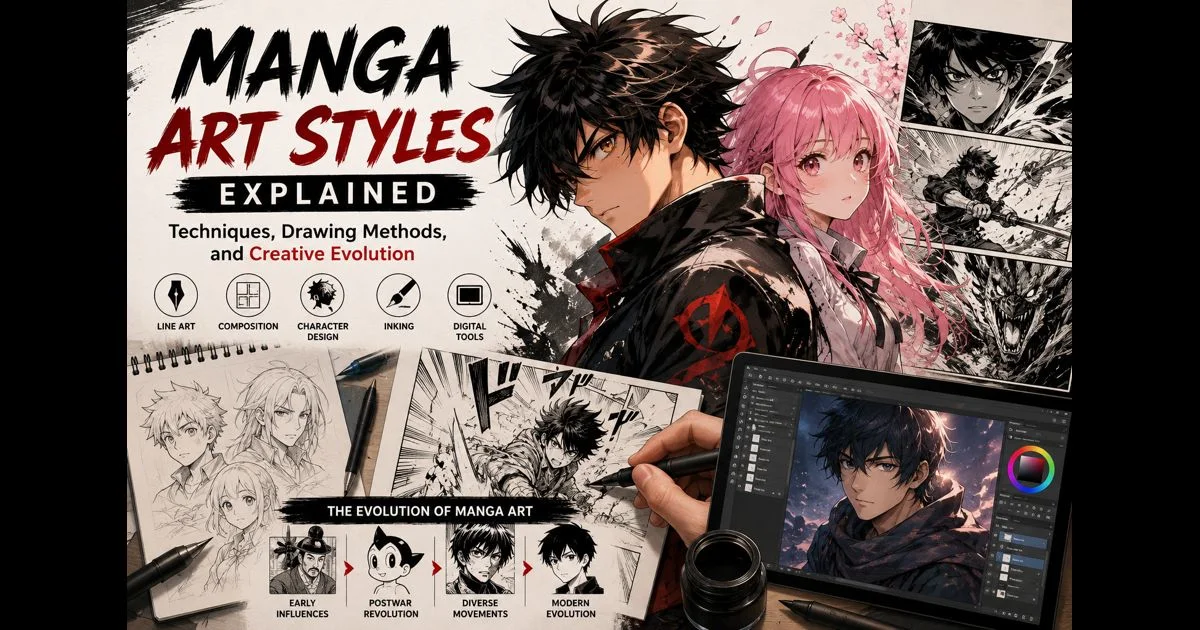
The Evolution of Manga Art Styles
Modern manga did not emerge overnight. Its visual language developed through decades of artistic experimentation, cultural change, technological advancement, and evolving reader expectations. Today’s manga reflects a blend of traditional Japanese aesthetics, Western illustration, cinematic storytelling, and digital innovation, creating one of the world’s most recognizable visual mediums.
Understanding this evolution helps explain why manga encompasses everything from highly stylized comedy to remarkably realistic historical drama while remaining instantly identifiable.
Early Foundations of Manga Art
The roots of manga stretch back centuries through Japanese visual storytelling traditions. Illustrated scrolls known as emaki combined images with narrative, allowing readers to follow stories through sequential artwork long before modern comics existed. Woodblock prints (ukiyo-e) later introduced bold outlines, dramatic compositions, expressive movement, and simplified forms that continue influencing manga illustration today.
During the late nineteenth and early twentieth centuries, political cartoons, satirical magazines, newspaper comics, and illustrated publications gradually shaped the foundations of modern manga. Artists began experimenting with recurring characters, serialized storytelling, and visual humor, laying the groundwork for the industry that would flourish after World War II.
The Postwar Revolution
The greatest transformation came during Japan’s postwar publishing boom. Affordable magazines and serialized storytelling introduced readers to longer narratives filled with memorable characters and cinematic pacing. Instead of isolated comic strips, artists began creating expansive adventures that encouraged readers to follow stories for months or even years.
One of the most influential figures during this period was Osamu Tezuka, whose storytelling techniques permanently changed manga production. Inspired by filmmaking, Tezuka introduced dynamic camera angles, expressive facial acting, dramatic close-ups, and carefully paced page layouts that made readers feel as though they were watching a movie unfold on paper.
His influence established many visual conventions that remain common throughout manga today, including emotional exaggeration, cinematic transitions, and character-focused storytelling.
The Rise of Diverse Artistic Movements
As readership expanded, manga diversified into numerous artistic directions. During the 1960s, the gekiga movement introduced darker, more realistic artwork aimed at adult audiences. Instead of exaggerated expressions and youthful adventures, these stories explored politics, crime, psychology, history, and social issues through grounded illustration and mature themes.
Publishers also expanded their magazine offerings, encouraging artists to experiment with different genres and visual identities. Weekly and monthly serialization demanded efficient storytelling, helping artists develop highly recognizable styles capable of communicating emotion quickly while maintaining consistency across hundreds of pages.
This culture of experimentation continues today, allowing manga artists to push creative boundaries while remaining accessible to readers.
Traditional Japanese Artistic Influences
Although manga constantly evolves, many traditional Japanese artistic principles remain visible in contemporary artwork.
The influence of ukiyo-e appears through strong contour lines, simplified forms, balanced negative space, and compositions that prioritize readability over photorealistic accuracy. Artists often use bold silhouettes and carefully controlled line variation to guide readers’ attention through each page.
Japanese calligraphy has also left a lasting mark on manga illustration. Brush pressure, stroke direction, and line rhythm all contribute to emotional expression. A single confident line can communicate elegance, aggression, calmness, or explosive energy depending on how it is executed.
Rather than treating every line equally, manga artists intentionally vary thickness and movement to create visual rhythm throughout a page.
Theater, Cinema, and Visual Storytelling
Traditional performance arts such as Kabuki and Noh introduced highly stylized poses, symbolic gestures, dramatic facial expressions, and carefully choreographed movement. Many of these theatrical traditions remain recognizable in manga, where a character’s posture, clothing, or hand gesture often communicates emotion before dialogue appears.
Film has become another major influence. Storyboarding techniques, cinematic framing, lighting, pacing, and editing rhythms all shape modern manga composition. Artists frequently alternate between wide establishing shots, intimate close-ups, dramatic perspective shifts, and silent reaction panels to create emotional impact similar to film editing.
Instead of relying solely on dialogue, manga often tells its stories visually through composition, movement, and carefully controlled pacing.
The Digital Era of Manga
The introduction of digital illustration has transformed manga production without replacing its artistic foundations.
Professional artists now use software capable of generating perspective grids, screentones, speech balloons, lighting effects, and panel layouts in a fraction of the time previously required by traditional methods. Digital tools have streamlined production while giving artists greater flexibility to revise pages without sacrificing quality.
Online publishing has further expanded creative opportunities. Independent creators can now share work globally through digital platforms, receive immediate audience feedback, and develop careers without relying exclusively on traditional print serialization.
Despite these technological changes, successful manga still depends on the same core principles that have guided artists for decades: expressive characters, compelling storytelling, thoughtful composition, and artwork that serves the narrative above all else.
Major Manga Art Styles
One of manga’s greatest strengths is its remarkable artistic diversity. While readers often categorize manga according to demographic labels such as shonen, shojo, seinen, and josei, these categories also represent distinct approaches to visual storytelling. Each style emphasizes different artistic priorities, emotional rhythms, and methods of engaging readers.
Although modern creators frequently blend influences across genres, understanding these major styles provides valuable insight into how artistic choices support different types of stories.
Shonen Manga Art Style
Shonen manga is known for its energetic visuals, bold compositions, and dynamic sense of movement. Artists prioritize excitement by using exaggerated perspectives, dramatic foreshortening, impactful speed lines, and high-contrast inking that gives action scenes tremendous momentum.
Character designs tend to be immediately recognizable. Distinctive hairstyles, iconic clothing, symbolic accessories, and memorable silhouettes help readers identify characters instantly, even during complex battle sequences.
Action scenes often sacrifice background detail in favor of visual energy. Motion effects, explosive panel layouts, and dramatic camera angles keep readers emotionally engaged while reinforcing themes of determination, friendship, perseverance, and personal growth.
Rather than striving for realism, shonen artwork emphasizes clarity, excitement, and constant forward movement.
Shojo Manga Art Style
Shojo manga approaches visual storytelling from a different perspective, focusing on emotional expression rather than physical action.
Delicate line work, elegant character proportions, flowing hair, decorative backgrounds, and carefully layered screentones create an atmosphere that supports romance, friendship, personal growth, and emotional conflict.
Panel layouts often become more open and expressive than those found in action-oriented manga. Flowers, sparkles, abstract textures, and symbolic imagery frequently blend into compositions to visualize emotions that cannot easily be expressed through dialogue alone.
Facial expressions receive extraordinary attention. Small changes in eye shape, mouth position, or posture communicate subtle emotional shifts, allowing readers to connect deeply with characters throughout the story.
Negative space also plays a significant role, giving emotional moments room to breathe without overwhelming readers with excessive visual information.
Seinen Manga Art Style
Seinen manga generally targets mature audiences, allowing artists to explore greater realism, psychological complexity, and sophisticated visual storytelling.
Illustrations often feature realistic anatomy, detailed environments, textured shading, cinematic lighting, and carefully observed architecture. Artists invest significant attention in atmosphere, using shadows, composition, and environmental detail to reinforce themes of mystery, suspense, morality, or historical realism.
Rather than relying on exaggerated reactions, seinen characters communicate emotion through restrained facial expressions, body language, silence, and subtle visual symbolism.
Panel pacing also slows considerably. Readers are encouraged to observe environments, interpret visual clues, and absorb emotional tension through thoughtful composition instead of rapid action alone.
Josei Manga Art Style
Josei manga shares certain visual qualities with shojo while presenting more grounded stories centered on adult experiences, careers, relationships, family life, and personal identity.
Character designs typically appear more natural than those found in younger demographics. Fashion, hairstyles, body language, and facial expressions reflect contemporary adult life while maintaining the elegance associated with manga illustration.
Rather than emphasizing dramatic fantasy elements, josei artwork often focuses on realistic environments, nuanced emotional interaction, and believable everyday situations. Clothing, interiors, workplace settings, and subtle gestures become important storytelling tools that reveal personality without requiring extensive exposition.
This understated artistic approach allows emotional complexity to emerge naturally through observation instead of visual exaggeration.
Comparing the Major Manga Art Styles
Although these categories have distinct characteristics, modern manga increasingly blends artistic influences across genres. Many contemporary creators borrow the emotional expressiveness of shojo, the cinematic realism of seinen, the dynamic action of shonen, and the mature interpersonal storytelling of josei to create entirely original visual identities.
The most successful manga artists understand that style is not simply about appearance—it is about choosing artistic techniques that strengthen storytelling. Every line, shadow, composition, and character design decision contributes to how readers experience the narrative, making artistic style one of the most powerful storytelling tools available in manga.
Distinctive Characteristics of Manga Art
Regardless of genre, successful manga shares a common goal: telling compelling stories through clear, expressive visuals. While every artist develops their own approach, several artistic principles consistently define manga illustration. From line work and shading to visual rhythm and page balance, these elements work together to guide readers naturally through the story.
Understanding these characteristics helps readers appreciate the craftsmanship behind manga while giving aspiring artists practical insight into professional illustration techniques.
Line Work and Inking Techniques
Line work is one of the most recognizable features of manga art. Every stroke serves a purpose, helping define form, establish depth, suggest movement, and communicate emotion. Professional artists carefully vary line thickness instead of using a uniform outline throughout the page.
Heavy outer contours separate important characters from the background, while thinner interior lines describe facial features, clothing folds, hair strands, and delicate textures. This variation creates visual hierarchy, allowing readers to instinctively recognize where their attention should focus.
Traditional manga artists commonly work with specialized dip pens, each producing a distinct type of line.
- G-Pen creates bold, flexible strokes ideal for action scenes and expressive characters.
- Maru Pen produces extremely fine lines suited for facial details, intricate textures, and delicate illustrations.
- Kabura Pen offers a balanced line width that works well for backgrounds and general inking.
- Brush pens create fluid strokes with dramatic thickness variation, making them excellent for shadows, expressive effects, and calligraphic accents.
Digital artists recreate these traditional tools using pressure-sensitive brushes that mimic natural ink behavior while providing greater flexibility for editing and refinement.
Creating Depth Through Line Variation
Professional manga rarely depends on outlines alone. Artists manipulate line weight to suggest distance, lighting, and form.
Objects closer to the viewer often receive thicker outlines, while distant elements use lighter, finer lines. Areas facing direct light may contain thinner contours, whereas shadowed regions become heavier and more pronounced. Hair strands overlap naturally through varying stroke widths, creating volume without excessive detail.
This subtle control makes even monochrome artwork appear rich and dimensional.
Motion, Energy, and Visual Effects
Movement plays an essential role in manga storytelling. Rather than relying solely on realistic animation principles, artists use graphic effects to amplify action and emotion.
Speed lines remain one of manga’s signature techniques. Carefully placed directional lines emphasize acceleration, impact, tension, or dramatic focus. Their density, thickness, and direction all influence how readers perceive movement.
Additional effects include:
- Impact bursts that emphasize collisions or sudden actions.
- Feathered hatching that softens transitions between light and shadow.
- Jagged energy lines that communicate intensity or instability.
- Spot blacks that anchor compositions and increase visual contrast.
- Motion blur techniques that imply rapid movement without overcrowding the artwork.
These techniques function as visual storytelling tools rather than decorative effects.
Screentones and Shading Techniques
Because most manga is published in black and white, artists rely on shading techniques to create atmosphere, depth, and texture without using color.
Traditional screentones consisted of adhesive sheets containing printed dot patterns that artists manually cut and applied to artwork. Although digital production has largely replaced physical tone sheets, the visual language remains remarkably similar.
Today’s manga artists commonly use:
- Halftone dot patterns
- Gradient screentones
- Noise textures
- Crosshatching
- Parallel hatching
- Soft digital gradients
- Texture overlays
- Selective solid black fills
Each method contributes differently to mood and readability.
Dense crosshatching often conveys realism and psychological tension, while smooth gradient tones create softer emotional scenes. Minimal shading can produce clean, contemporary aesthetics, whereas heavy blacks generate dramatic contrast suited to suspense or horror.
Rather than adding texture everywhere, experienced artists apply tones strategically so important characters remain visually dominant.
Color in Modern Manga
Although serialized manga traditionally appears in monochrome, color plays an increasingly important role in modern publishing.
Cover illustrations, promotional artwork, anniversary chapters, and digital-first releases frequently feature full-color artwork that reflects each series’ identity.
Genre often influences palette selection.
Fantasy adventures may feature vibrant, saturated colors that emphasize magical worlds. Romance series frequently use softer pastel combinations that reinforce warmth and intimacy. Psychological dramas often rely on muted palettes with controlled contrast to support serious themes.
Many digital manga also experiment with limited accent colors, duotone palettes, and cinematic lighting effects optimized for mobile reading.
Regardless of palette, successful color design always supports storytelling rather than distracting from it.
Character Design in Manga
Character design forms the emotional foundation of manga. Readers spend hundreds—or even thousands—of pages with protagonists, making memorable visual design essential. Every hairstyle, facial feature, costume, posture, and expression communicates personality before dialogue even begins.
Professional character design balances artistic appeal with storytelling clarity.
Building Characters Through Shape Language
Experienced artists often begin character design using simple geometric forms.
Rounded shapes communicate warmth, innocence, optimism, and friendliness.
Angular forms suggest determination, danger, confidence, or aggression.
Rectangular silhouettes imply stability, maturity, professionalism, or reliability.
These underlying shapes influence hairstyles, clothing, body proportions, and even facial structure, helping readers immediately understand a character’s personality.
Proportions and Anatomy
Manga embraces enormous stylistic flexibility. Some series feature highly exaggerated proportions, while others approach photographic realism.
Shonen protagonists often possess athletic builds with simplified muscle structure that supports energetic action scenes.
Shojo characters frequently emphasize graceful limbs, elegant posture, expressive hands, and flowing movement.
Seinen and josei generally remain closer to realistic anatomy while selectively exaggerating features that strengthen emotional communication.
Even highly stylized characters rely on an understanding of anatomy. Professional artists learn realistic body structure first before simplifying forms to match their chosen style.
Strong fundamentals allow stylization to remain believable.
Costume Design as Storytelling
Clothing does far more than decorate characters.
Uniforms establish occupations.
Accessories reveal personal interests.
Color choices communicate personality.
Fabric textures indicate historical period, economic status, or cultural background.
Even small details—such as rolled sleeves, untied neckties, worn shoes, or carefully maintained uniforms—can reveal habits and personality without requiring exposition.
Well-designed costumes become part of a character’s visual identity, making silhouettes instantly recognizable.
Hairstyles and Visual Identity
Hair is one of manga’s most distinctive design elements.
Artists often exaggerate hairstyles because they remain visible even from a distance or within crowded action scenes.
Rather than simply appearing stylish, hairstyles frequently reinforce personality.
Loose flowing hair may suggest elegance.
Sharp spikes imply energy.
Messy hair can communicate carelessness.
Precisely maintained styles often indicate discipline or professionalism.
Combined with facial structure and clothing, hairstyles contribute significantly to character recognition.
Facial Expressions and Emotional Storytelling
Manga is celebrated for its expressive faces.
Rather than pursuing strict realism, artists exaggerate expressions to strengthen emotional clarity.
Common visual symbols include:
- Sweat drops representing nervousness.
- Vein symbols indicating frustration.
- Sparkling eyes expressing admiration.
- Chibi transformations emphasizing comedy.
- Dark shadow overlays suggesting despair or fear.
These conventions have become an internationally recognized visual language understood even by readers unfamiliar with Japanese culture.
Professional artists combine these symbolic techniques with realistic facial anatomy, allowing exaggerated emotions to remain believable rather than cartoonish.
Maintaining Character Consistency
One hallmark of professional manga is visual consistency.
Characters remain recognizable regardless of camera angle, lighting, emotion, or costume.
Artists create reference sheets showing:
- Front view
- Side profile
- Rear view
- Facial expressions
- Clothing details
- Height comparisons
- Color references
- Pose variations
These references help maintain continuity across long-running series where characters may appear thousands of times.
Panel Layout and Composition
Page composition is one of manga’s most powerful storytelling tools. Long before readers consciously process dialogue, they respond to layout, rhythm, and visual flow. Effective panel composition controls pacing, builds suspense, emphasizes emotional moments, and guides the eye naturally from one scene to the next.
The strongest manga pages appear effortless because every panel has been carefully arranged to support the narrative.
Guiding the Reader’s Eye
Japanese manga is traditionally read from right to left, making visual flow an essential consideration during page design.
Artists carefully position characters, dialogue balloons, action, and backgrounds so readers instinctively follow the intended reading order without confusion.
Eye direction, body movement, perspective lines, lighting, and even environmental details subtly direct attention across each page.
When composition works well, readers rarely notice it—they simply become immersed in the story.
Controlling Pacing Through Panel Size
Panel size directly influences how readers experience time.
Small panels compress action, allowing rapid conversations or fast-paced sequences to unfold quickly.
Medium-sized panels establish steady rhythm and support balanced storytelling.
Large panels slow readers down, emphasizing dramatic reveals, emotional turning points, or breathtaking scenery.
Splash pages, which occupy an entire page or double-page spread, create memorable moments by encouraging readers to pause and absorb the artwork before continuing.
Professional artists constantly adjust panel size to match the emotional intensity of each scene.
Dynamic and Static Layouts
Action-heavy chapters often abandon rigid grids in favor of energetic layouts.
Diagonal panels, overlapping borders, dramatic perspective shifts, and full-page illustrations create excitement while reinforcing movement.
By contrast, dialogue-driven scenes typically return to more structured compositions.
Straight panel borders, balanced spacing, and consistent layouts help readers focus on conversations, emotional development, and subtle character interactions.
Alternating between dynamic and static page designs creates rhythm throughout an entire chapter, preventing visual fatigue while maintaining reader engagement.
Camera Angles and Cinematic Composition
Modern manga borrows extensively from filmmaking.
Artists frequently alternate between:
- Establishing shots
- Wide environmental views
- Medium character shots
- Close-ups
- Extreme close-ups
- Bird’s-eye perspectives
- Worm’s-eye perspectives
- Over-the-shoulder compositions
Each camera angle influences how readers interpret emotion, power, tension, or intimacy.
A dramatic low-angle view may make a character appear heroic, while a high-angle composition can emphasize vulnerability or isolation.
These cinematic choices transform static illustrations into immersive visual storytelling.
The Importance of Negative Space
Not every panel should be crowded with detail.
Professional manga often uses empty space deliberately to strengthen emotional impact.
Quiet scenes benefit from minimal backgrounds, allowing facial expressions and dialogue to carry the emotional weight.
Negative space also improves readability, prevents visual clutter, and creates contrast before action-heavy sequences.
Some of the most memorable manga moments occur not because the page is visually busy, but because the artist knows when simplicity communicates more effectively than complexity.
Traditional and Digital Manga Creation Workflows
The tools used to create manga have changed dramatically over the past two decades, but the artistic principles behind great storytelling remain the same. Many professional creators now combine traditional illustration techniques with modern digital production, creating flexible workflows that maximize both efficiency and creative control.
Traditional methods continue to offer unmatched tactile feedback and expressive ink variation, while digital software simplifies editing, page management, lettering, and publication. As a result, hybrid workflows have become increasingly common across the manga industry, allowing artists to preserve the character of hand-drawn artwork while benefiting from the speed and precision of modern technology.
Cultural Influences on Manga Art
Manga has never existed in isolation. Although deeply rooted in Japanese culture, its artistic language has continually evolved by absorbing influences from traditional art, international illustration, cinema, animation, fashion, architecture, and digital media. At the same time, manga has become one of Japan’s most influential cultural exports, inspiring artists and comic creators around the world.
This ongoing exchange of ideas has transformed manga into a truly global art form while preserving the storytelling principles that make it unique.
Traditional Japanese Art Continues to Shape Modern Manga
Many of the visual techniques found in modern manga can be traced back to centuries-old Japanese artistic traditions.
The influence of ukiyo-e woodblock prints is especially noticeable in the use of strong contour lines, simplified shapes, dramatic compositions, and carefully balanced negative space. Rather than pursuing photographic realism, both ukiyo-e and manga emphasize visual clarity, rhythm, and expressive design.
Japanese calligraphy has also contributed significantly to manga illustration. The confidence of a single brushstroke, variations in pressure, and the natural rhythm of ink movement continue to inspire professional inking techniques today. Many artists intentionally allow line quality to remain organic instead of making every stroke mechanically perfect.
Traditional storytelling methods have also influenced pacing. Rather than rushing through every event, manga often allows quiet moments to develop naturally, encouraging readers to absorb atmosphere and emotion between major plot developments.
Theater and Performance Influence Visual Expression
Japanese performing arts have left a lasting mark on manga’s visual language.
Kabuki theater introduced dramatic poses, exaggerated gestures, symbolic costumes, and highly expressive facial acting that continue appearing throughout manga today. A single stance or hand movement can instantly communicate confidence, determination, fear, or authority.
Noh theater, with its restrained movement and emotional subtlety, has also influenced slower, more contemplative genres. Psychological manga frequently relies on silence, posture, and visual symbolism instead of dramatic dialogue.
These theatrical traditions demonstrate that storytelling extends beyond spoken words, an idea that remains central to manga composition.
The Influence of Cinema
Modern manga frequently borrows techniques from filmmaking.
Artists think like directors when planning pages, carefully selecting camera angles, framing, lighting, and pacing to maximize emotional impact.
Common cinematic techniques include:
- Establishing shots that introduce new environments.
- Close-ups that capture emotional reactions.
- Wide-angle scenes that emphasize scale.
- Over-the-shoulder perspectives during conversations.
- Dramatic lighting that reinforces mood.
- Silent reaction panels that build suspense.
Many readers describe manga as “reading a movie” because page layouts often mimic the rhythm of film editing.
This cinematic approach helps create immersive storytelling despite the medium consisting entirely of static illustrations.
Western Artistic Influences
International art has also shaped modern manga.
Early Disney animation inspired many artists to experiment with expressive facial features and simplified character design.
European illustrators introduced highly detailed environments, sophisticated architecture, and expansive world-building.
American superhero comics influenced dynamic anatomy, dramatic action poses, muscular proportions, and energetic compositions.
Rather than replacing Japanese artistic traditions, these influences blended naturally with existing techniques to create entirely new visual possibilities.
Today’s manga continues evolving through this creative exchange.
Manga’s Global Influence
The relationship now works in both directions.
Manga has profoundly influenced comic artists, animators, game designers, and illustrators throughout the world.
Western comics increasingly adopt:
- Decompressed storytelling
- Cinematic page layouts
- Expressive character reactions
- Dynamic speed effects
- Emotional visual symbolism
- Manga-inspired panel pacing
Independent creators across Europe, North America, South America, and Southeast Asia regularly incorporate manga techniques while adapting them to local storytelling traditions.
As a result, manga has become less of a regional art form and more of a global visual language.
Online Communities and Digital Platforms
The internet has dramatically accelerated artistic development.
Platforms such as Pixiv, WEBTOON, DeviantArt, ArtStation, Behance, Instagram, and social media communities allow artists to share work instantly with international audiences.
Digital communities provide opportunities to:
- Receive constructive feedback.
- Study professional workflows.
- Discover new artistic techniques.
- Participate in collaborative projects.
- Build audiences independently.
- Publish original stories without traditional publishers.
This accessibility has expanded the diversity of manga-inspired artwork worldwide.
Artists now learn from creators across multiple cultures instead of relying solely on local influences.
Mobile Publishing and New Reading Habits
Digital publishing has changed not only how manga is created but also how it is consumed.
Many creators now design artwork specifically for smartphones and tablets.
Vertical scrolling formats encourage:
- Taller panel compositions.
- Larger illustrations.
- More cinematic reveals.
- Increased color usage.
- Simplified page navigation.
While traditional printed manga remains enormously popular, digital-first storytelling continues introducing new artistic possibilities without abandoning the core principles of visual storytelling.
Techniques for Aspiring Manga Artists
Developing strong manga artwork requires far more than copying favorite characters. Professional artists spend years mastering observation, anatomy, perspective, composition, lighting, and storytelling before developing a recognizable personal style.
While every creator follows a unique path, certain practices consistently accelerate artistic growth.
Master the Fundamentals Before Style
Many beginners become overly focused on finding a signature style.
Professional artists usually recommend the opposite approach.
Strong fundamentals make every artistic style more convincing.
Essential skills include:
- Basic anatomy
- Perspective drawing
- Gesture sketching
- Composition
- Lighting
- Form construction
- Visual storytelling
- Page layout
Once these principles become intuitive, personal style develops naturally through repeated practice.
Build a Strong Reference Library
Professional manga artists constantly study references.
Useful sources include:
- Fashion photography
- Architecture
- Nature
- Historical clothing
- Animal anatomy
- Film stills
- Classical paintings
- Everyday life
- Human poses
Studying diverse references prevents artwork from becoming repetitive while improving realism and creativity.
Observation remains one of the fastest ways to improve artistic accuracy.
Learn Professional Manga Tools
Traditional manga artists often use:
- Bristol paper
- Japanese manuscript paper
- G-Pens
- Maru Pens
- Kabura Pens
- Brush pens
- Technical rulers
- Screentone sheets
- White correction ink
Digital artists commonly work with:
- Clip Studio Paint
- Procreate
- Photoshop
- Krita
- MediBang Paint
Modern illustration tablets provide pressure-sensitive drawing that closely recreates traditional inking while simplifying editing and page management.
Choosing expensive tools is less important than learning to use them effectively.
Practice Visual Storytelling
Drawing attractive characters alone does not create compelling manga.
Artists should regularly practice:
- Storyboarding
- Thumbnail sketches
- Camera angles
- Facial acting
- Body language
- Scene transitions
- Dialogue placement
- Silent storytelling
Each page should communicate clearly even before dialogue is read.
Professional manga succeeds because readers understand emotion visually.
Create Consistently
Improvement comes through regular production rather than occasional perfection.
Many professional artists recommend setting achievable weekly goals.
Examples include:
- One finished illustration every week.
- Daily gesture drawing.
- Monthly short comics.
- Expression studies.
- Background practice.
- Perspective exercises.
Small projects completed consistently often improve skills faster than endlessly revising unfinished artwork.
Practical Exercises for Improving Manga Skills
The following exercises help strengthen multiple areas of manga illustration:
Gesture Drawing
Complete quick one-minute figure sketches to improve movement, balance, and confidence.
Expression Sheets
Draw one character displaying fifteen or twenty different emotions using only facial changes.
Character Redesign
Redraw an existing character using completely different proportions, clothing, hairstyles, and shape language.
Panel Recreation
Study a professional manga page, then recreate the scene using different camera angles while preserving the story.
Four-Panel Comics
Produce short weekly comics that emphasize pacing, timing, and storytelling efficiency.
Background Studies
Practice drawing interiors, streets, landscapes, and architecture using accurate perspective.
Style Comparisons
Illustrate the same character in shonen, shojo, seinen, and realistic styles to better understand stylistic differences.
Documenting progress over months allows artists to identify strengths, weaknesses, and areas requiring additional practice.
Common Mistakes New Manga Artists Should Avoid
Every artist makes mistakes during the learning process. Recognizing these challenges early helps accelerate improvement while preventing frustrating habits from becoming permanent.
Copying Instead of Learning
Studying favorite artists is valuable, but copying their work without understanding the underlying principles limits artistic growth.
Instead of asking:
“How do they draw this?”
Ask:
“Why did they choose this composition, line weight, or camera angle?”
Understanding decisions produces lasting improvement.
Ignoring Anatomy
Stylized characters still rely on believable anatomy.
Without anatomical knowledge:
- Poses appear stiff.
- Movement feels unnatural.
- Clothing fits poorly.
- Facial expressions become inconsistent.
Learning realistic anatomy provides a stronger foundation for stylization.
Overusing Effects
Speed lines, impact bursts, screentones, and dramatic shadows lose effectiveness when overused.
Professional manga artists apply visual effects selectively so important moments retain maximum impact.
Less is often more.
Weak Backgrounds
Many beginners focus exclusively on characters.
However, environments establish mood, scale, geography, and atmosphere.
Even simplified backgrounds help readers understand where scenes occur.
Consistent environmental storytelling makes fictional worlds feel believable.
Crowded Page Layouts
Too many panels, excessive dialogue, or overly detailed compositions can overwhelm readers.
Good manga values clarity above complexity.
White space, thoughtful pacing, and organized composition improve readability.
How Professional Manga Artists Develop Their Style
One of the biggest misconceptions among beginners is believing that professional artists intentionally invent a unique style from the beginning.
In reality, most artistic identities emerge gradually through years of experimentation, observation, and consistent practice.
Study Broadly
Professional artists rarely study manga alone.
They also explore:
- Classical illustration
- Fine art
- Fashion design
- Photography
- Architecture
- Sculpture
- Graphic design
- Cinema
- Nature
Every discipline contributes new ideas that enrich visual storytelling.
Develop Consistent Habits
Recognizable style often comes from repetition.
Artists naturally develop preferences for:
- Line thickness
- Character proportions
- Facial structures
- Hair rendering
- Clothing folds
- Lighting
- Panel composition
- Shadow placement
Over time, these recurring choices become a distinctive artistic voice.
Accept Continuous Growth
Even internationally recognized manga artists continue refining their techniques throughout their careers.
Technology changes.
Publishing evolves.
Reader expectations shift.
Successful artists remain curious, experiment regularly, and continue learning without abandoning the storytelling principles that define their work.
Rather than searching for the perfect style, they focus on creating stronger stories, clearer drawings, and more meaningful visual experiences. Their artistic identity develops naturally as a result of consistent practice, thoughtful observation, and years of creative exploration.
The Future of Manga Art Styles
Manga has continuously evolved for decades, adapting to changes in technology, publishing, and reader expectations without losing its identity. While traditional pen-and-ink techniques remain highly respected, modern creators are embracing new tools and formats that expand creative possibilities rather than replace established artistic principles.
Today’s manga industry blends handcrafted illustration with digital production, allowing artists to work faster, collaborate more efficiently, and publish for audiences around the world. As technology continues advancing, manga art styles will likely become even more diverse, combining traditional craftsmanship with innovative visual storytelling.
The Rise of Digital-First Manga
Digital publishing has transformed how manga reaches readers. Many creators now publish directly through online platforms before pursuing print editions, giving independent artists opportunities that were once available only through major publishers.
Digital-first manga often takes advantage of features designed specifically for smartphones and tablets, including:
- Vertical scrolling layouts
- Full-color chapters
- Larger cinematic panels
- Optimized typography
- Interactive reading experiences
- Faster publication schedules
These formats allow artists to experiment with pacing and composition while making manga more accessible to international audiences.
Hybrid Artistic Workflows
Most professional manga artists no longer choose exclusively between traditional and digital production. Instead, they combine both approaches.
A typical hybrid workflow may include:
- Thumbnail sketches on paper or tablet.
- Digital page layouts and perspective guides.
- Traditional pencil sketches.
- Hand-inked line art.
- High-resolution scanning.
- Digital screentones and shading.
- Lettering and sound effects.
- Final corrections and publishing.
This workflow preserves the organic quality of traditional ink while benefiting from digital efficiency.
3D References and Background Production
Creating detailed environments has traditionally been one of the most time-consuming aspects of manga production.
Modern software now allows artists to use 3D references for:
- Buildings
- Furniture
- Vehicles
- Interior layouts
- City streets
- Perspective grids
- Props
These references help maintain accurate perspective and continuity throughout long-running series.
Experienced artists rarely leave 3D models untouched. Instead, they simplify, redraw, or ink over them so backgrounds blend naturally with hand-drawn characters.
The technology serves as a production tool rather than replacing artistic skill.
AI-Assisted Creative Tools
Artificial intelligence is beginning to influence certain stages of manga production, particularly repetitive technical tasks.
Some AI-assisted tools can help generate:
- Perspective guides
- Basic lighting references
- Flat colors
- Preliminary layouts
- Object references
- Texture suggestions
However, successful manga still depends on artistic judgment.
Storytelling, composition, character acting, emotional timing, and visual style remain deeply human creative decisions. AI may accelerate production workflows, but it cannot replace an artist’s ability to communicate emotion, personality, and narrative through deliberate artistic choices.
As these technologies continue developing, they are likely to become supportive production assistants rather than substitutes for creative authorship.
Global Collaboration
The manga industry has become increasingly international.
Artists, writers, assistants, editors, translators, and letterers now collaborate across multiple countries using cloud-based production tools.
This global collaboration has introduced:
- Diverse artistic influences
- Faster localization
- International publishing opportunities
- Cross-cultural storytelling
- Expanded readership
As a result, manga-inspired artwork continues growing beyond Japan while preserving the storytelling techniques that define the medium.
Emerging Artistic Trends
Several visual trends are becoming increasingly common throughout modern manga production.
These include:
- Cleaner minimalist line work
- Cinematic lighting techniques
- Painterly digital textures
- Selective color accents
- More expressive typography
- Genre blending
- Stylized environmental storytelling
- Greater diversity in character design
- Mobile-first page composition
Although artistic trends will continue changing, the most successful creators focus on storytelling rather than simply following popular aesthetics.
Styles may evolve, but strong visual communication remains timeless.
Conclusion
Manga art styles represent far more than distinctive drawing techniques. They are visual storytelling systems that combine illustration, composition, pacing, symbolism, and emotion into a uniquely immersive reading experience. Every artistic choice—from the thickness of a single ink line to the placement of an entire page layout—helps shape how readers experience each scene.
Throughout its history, manga has continuously balanced tradition with innovation. Classical Japanese art, theatrical performance, cinematic storytelling, and modern digital technology have all contributed to the extraordinary diversity found in contemporary manga. From energetic shonen adventures and emotionally expressive shojo romances to grounded seinen realism and sophisticated josei narratives, each artistic approach demonstrates how visual style can strengthen storytelling in different ways.
For aspiring artists, developing a personal manga style is not about copying successful creators or chasing trends. It begins with mastering the fundamentals of drawing, studying anatomy, perspective, lighting, composition, and storytelling before gradually refining individual artistic preferences. Style develops naturally through observation, experimentation, consistency, and continuous learning.
Technology will undoubtedly continue changing how manga is created, but the heart of the medium remains unchanged. Readers continue returning to manga because of compelling characters, engaging stories, expressive artwork, and thoughtful visual storytelling. Whether created entirely with traditional ink or produced using modern digital tools, exceptional manga succeeds because every artistic decision serves the narrative.
If you’re interested in drawing manga, don’t feel pressured to discover your signature style immediately. Explore different genres, study professional artists, experiment with techniques, and create consistently. Every sketch, every finished page, and every new project builds experience that gradually shapes your own artistic voice. The most memorable manga artists are not those who imitate others perfectly—they are those who learn the fundamentals well enough to tell stories in a way that feels entirely their own.
Frequently Asked Questions
What are the main characteristics of manga art styles?
Manga art styles are known for expressive line work, dynamic page composition, distinctive character designs, visual storytelling, and effective use of black-and-white contrast. Although artistic approaches vary between genres, most manga emphasizes clarity, emotion, movement, and readable panel layouts that guide readers naturally through the story.
How do different manga genres influence artistic style?
Each genre prioritizes different visual techniques. Shonen manga typically features energetic action, bold lines, and dynamic compositions. Shojo manga often emphasizes delicate line work, expressive characters, and decorative layouts. Seinen focuses on realism, cinematic lighting, and detailed environments, while josei generally presents more natural character designs and mature emotional storytelling.
Can manga art styles be influenced by Western comics?
Yes. Many manga artists study Western comics, animation, cinema, and illustration alongside traditional Japanese art. Likewise, Western comic creators frequently adopt manga-inspired storytelling techniques, expressive character acting, and cinematic page layouts. This ongoing exchange continues shaping modern comic art around the world.
How long does it take to develop a personal manga art style?
There is no fixed timeline. Most professional artists spend years improving anatomy, perspective, composition, lighting, and storytelling before developing a consistent visual identity. Rather than forcing originality, artists gradually discover their style through regular practice, experimentation, and observation.
What drawing tools do professional manga artists commonly use?
Traditional manga artists often use G-pens, Maru pens, Kabura pens, brush pens, Bristol paper, manuscript paper, rulers, and screentones. Digital creators commonly work with software such as Clip Studio Paint, Procreate, Photoshop, Krita, or MediBang Paint alongside pressure-sensitive drawing tablets.
Is digital manga replacing traditional manga art?
Digital production has become increasingly common because it improves efficiency and simplifies editing, but traditional techniques remain highly respected. Many professionals combine both methods through hybrid workflows that preserve the expressive qualities of hand-drawn artwork while benefiting from digital production tools.
Which manga art style is easiest for beginners?
No single manga style is universally easier than another. Beginners benefit most from learning drawing fundamentals before focusing on stylistic preferences. Building strong skills in anatomy, perspective, gesture drawing, composition, and storytelling creates a solid foundation for any artistic direction.
Why do manga characters often have large expressive eyes?
Large eyes allow artists to communicate emotion more clearly through subtle changes in shape, highlights, eyelids, and pupil size. While not every manga style uses exaggerated eyes, expressive facial features remain one of the medium’s most recognizable storytelling techniques.
How important is anatomy when drawing manga?
Anatomy is essential, even for highly stylized artwork. Understanding realistic body structure helps artists simplify forms while maintaining believable movement, balance, and proportions. Strong anatomical knowledge gives creators greater freedom to exaggerate designs without sacrificing visual credibility.
Can artists combine multiple manga art styles?
Absolutely. Many contemporary manga artists blend influences from shonen, shojo, seinen, josei, Western comics, traditional Japanese art, and digital illustration to create unique visual identities. The strongest artistic styles often emerge from understanding multiple approaches rather than following a single formula.