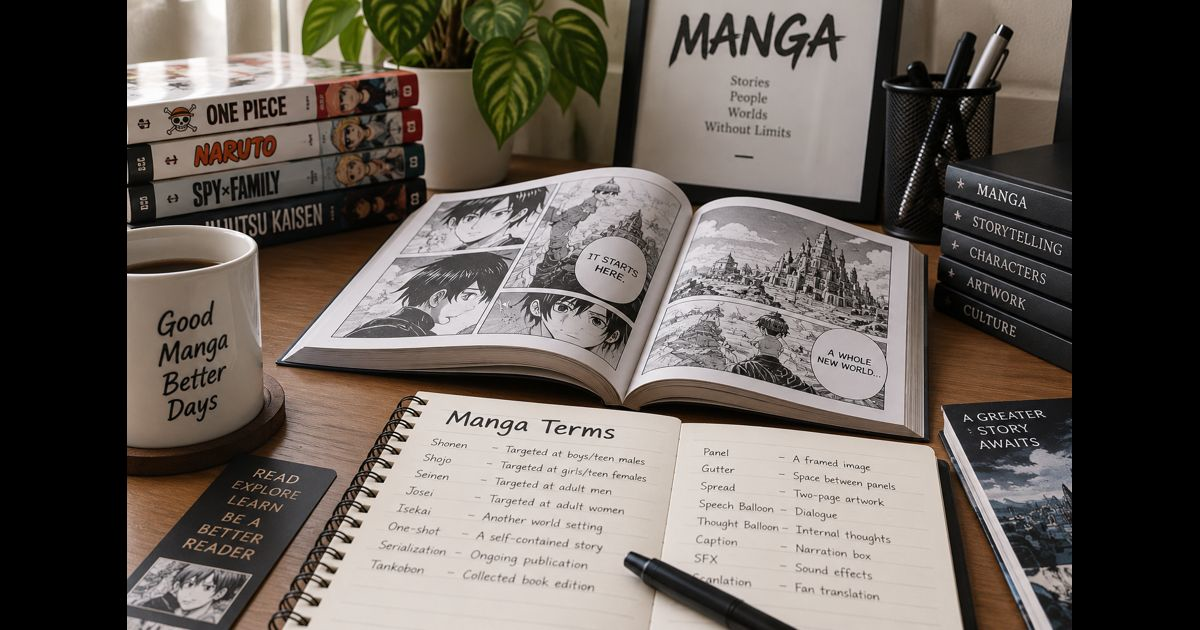
Manga has its own vocabulary for reading direction, page design, publishing, audience categories, storytelling, translation, and fandom. This manga terms glossary explains the words readers are most likely to encounter on book covers, store pages, publisher announcements, reviews, and community discussions.
The most important distinction is simple: terms such as shonen and shojo describe intended readership, while terms such as romance, fantasy, and mystery describe genre. Neither one automatically determines a book's age rating.
Essential Manga Terms at a Glance
|
Term |
Plain-English meaning |
|
Manga |
Comics originating in Japan; outside Japan, the word usually refers specifically to Japanese comics. |
|
Mangaka |
A manga creator, often the artist and writer, although creative roles may be divided. |
|
Chapter |
One installment of a manga story. |
|
Volume |
A book collecting several chapters, though the exact number varies. |
|
One-shot |
A self-contained comic published as a single installment. |
|
Serialization |
Publication of a story in recurring installments. |
|
Tankobon |
A Japanese book edition that commonly collects chapters previously serialized. |
|
Panel |
One framed image or unit of action on a comics page. |
|
Gutter |
The blank space between panels. |
|
Spread |
Artwork or a scene extending across two facing pages. |
|
Shonen |
Manga marketed primarily to boys and teenage male readers. |
|
Shojo |
Manga marketed primarily to girls and teenage female readers. |
|
Seinen |
Manga marketed primarily to adult male readers. |
|
Josei |
Manga marketed primarily to adult female readers. |
|
Isekai |
A story built around entry into another world or reality. |
|
Scanlation |
A fan-produced scan and translation, usually distributed without the rights holder's authorization. |
Reading and Page-Layout Terms
Right-to-left reading
Most Japanese manga editions begin at what an English-language reader may first consider the back of the book. Pages usually progress from right to left, and panels on each page generally follow the same direction before moving downward. This is the intended layout, not a printing mistake. A fuller explanation of how to read manga right to left can help when a complex page has overlapping panels or unusual visual cues.
Some older translated editions were flopped, meaning the artwork was mirrored so it could be read from left to right. Flipping can alter composition, reverse handedness, and make signs or clothing details appear incorrectly, so modern publishers usually preserve the original orientation.
Panel or koma
A panel is one visual unit on a comics page. The Japanese word koma is sometimes used with the same meaning. Panels can show separate moments, simultaneous reactions, changes of viewpoint, or a continuous movement broken into stages.
Gutter
The gutter is the space between panels. It separates images, but it also represents an implied transition. Readers mentally connect the action before and after that space, which makes the gutter an important part of pacing.
Tier
A tier is a horizontal row of panels. Not every manga page uses clear rows, but the word is useful when describing a regular grid or explaining a page's visual path.
Speech balloon and thought balloon
A speech balloon, often called a speech bubble, contains spoken dialogue. Its outline can suggest volume, tone, hesitation, or an electronic voice. A thought balloon presents internal speech, although manga also conveys thought through captions or unbordered text.
Caption
A caption is a box or block of narration separate from spoken dialogue. It may establish time and place, deliver a narrator's voice, or present a character's internal perspective.
Sound effects or SFX
SFX is short for sound effects. In translated manga, Japanese sound-effect lettering may be replaced, subtitled nearby, or explained in a glossary. Sound effects can represent obvious noises, movement, atmosphere, texture, silence, or even an emotional state.
Splash page
A splash page is a full-page or nearly full-page image used for emphasis. It may introduce a chapter, establish a setting, reveal a character, or give a dramatic moment more visual weight.
Double-page spread
A double-page spread is one composition extending across two facing pages. The central binding can hide part of printed artwork, so artists and book designers account for the fold when placing faces, text, and other important details.
Yonkoma or 4-koma
Yonkoma, also written 4-koma, is a four-panel comic format. The panels are commonly stacked vertically, and many strips use a setup, development, turn, and conclusion structure. Yonkoma often supports comedy, but the format is not limited to jokes.
Page turn
A page turn is the transition created when a reader physically or digitally advances to the next page. Creators often place a reveal after the turn so it is not visible too early.
Story and Release Terms
Chapter
A chapter is one installment of a manga. Chapter length and release frequency differ by title and publication. A chapter may first appear in a print magazine, an anthology, a publisher's app, or another digital service.
Volume
A volume is a bound or digital book containing a group of chapters. Volume numbering refers to collected books, not individual chapters. Bonus pages, creator notes, revised artwork, and short extras may appear in a volume even when they were absent from the original serialization.
Series
A series is a work released across multiple installments. Some series tell one continuous story; others use episodic chapters or largely self-contained arcs.
One-shot or yomikiri
A one-shot is a complete comic presented in one installment. The Japanese term yomikiri conveys a work designed to be read through as a complete piece. A successful one-shot may later inspire a serialized version, but it is not merely an unfinished first chapter.
Serialization
Serialization is the recurring publication of a manga in chapters. Japanese series have traditionally appeared in weekly, monthly, or other periodic magazines, while many newer works serialize through websites and apps. Collected volumes usually follow after enough chapters have appeared.
Story arc
A story arc is a connected section of a larger narrative, usually centered on a particular conflict, location, goal, or stage of character development. One arc can span part of a volume or several volumes.
Hiatus
A hiatus is an official or practical pause in publication. It does not by itself mean that a series has been cancelled. Pauses may result from health, production demands, scheduling, research, or editorial decisions.
Cancelled, completed, and ongoing
An ongoing manga is still receiving new installments. A completed manga has reached its intended published ending. A cancelled manga stops because publication is discontinued, sometimes with a shortened ending and sometimes without full resolution.
Spin-off
A spin-off is a separate work derived from an existing title. It may follow a supporting character, use a different setting or tone, retell events from another viewpoint, or present an alternate continuity.
Adaptation
An adaptation retells a work in another medium, such as an anime series, film, stage production, or novel. Adaptations can change pacing, omit scenes, rearrange events, or create original material, so manga and anime versions are not always interchangeable.
Manga Formats and Editions
Manga magazine
A manga magazine is a periodical containing chapters from multiple series. The magazine version is often the first public form of a serialized chapter. The word magazine here describes the publication model, not a single-title collected book.
Tankobon
A tankobon is a standalone Japanese book format. In English-language manga discussion, it usually means a collected volume containing chapters that appeared earlier as a serial. It is a format, not a genre, and the word does not mean an entire completed series.
Omnibus
An omnibus combines material from multiple standard volumes into one larger book. A three-in-one edition, for example, generally collects the equivalent of three regular volumes, though page size, paper, translation, and bonus material can differ.
Bunkobon
A bunkobon is a compact Japanese paperback edition. Manga reissued in bunko format often has a smaller trim size and may collect more material per book than the original tankobon release.
Kanzenban
A kanzenban is a premium or more complete reissue. Depending on the series, it may include a larger page size, higher-quality paper, color pages, restored material, new covers, or fewer total books. The exact features are publisher-specific.
Shinsoban
A shinsoban is a new-edition release. It may have redesigned covers, revised contents, new typesetting, or added material, but the label alone does not guarantee a definitive edition.
Deluxe edition
A deluxe edition is a publisher's premium release, often with a larger trim, hardcover binding, upgraded paper, or additional material. Unlike tankobon or bunkobon, “deluxe” is mainly a marketing description, so specifications should be checked title by title.
Digital edition
A digital edition is an authorized electronic release intended for a phone, tablet, computer, or e-reader. Page-based manga may retain right-to-left navigation, while digital-first comics can use other layouts.
Web manga and webtoon
Web manga is manga first published online. Webtoon commonly refers to a digital-comics format associated with South Korea and frequently designed as a long vertical scroll. The words can overlap in casual use, but they do not identify the same national tradition or page structure.
Light novel
A light novel is a prose book, usually with some illustrations. It is not manga. A franchise may have both light-novel and manga versions, and either version can be the source for an anime adaptation.
Manga Demographics: Audience Labels, Not Genres
Manga demographics reflect the readership a publication is primarily marketed toward. They do not impose a strict boundary on who may read a title, and they do not reliably describe its plot. The same genre can appear across several demographics. An age rating is a separate content-guidance decision made by a publisher, retailer, platform, or ratings system.
Kodomo
Kodomo means children and is used for manga aimed primarily at young readers. Stories may favor direct plots, accessible language, comedy, learning, or adventure, but the label refers to the audience rather than a single creative style.
Shonen
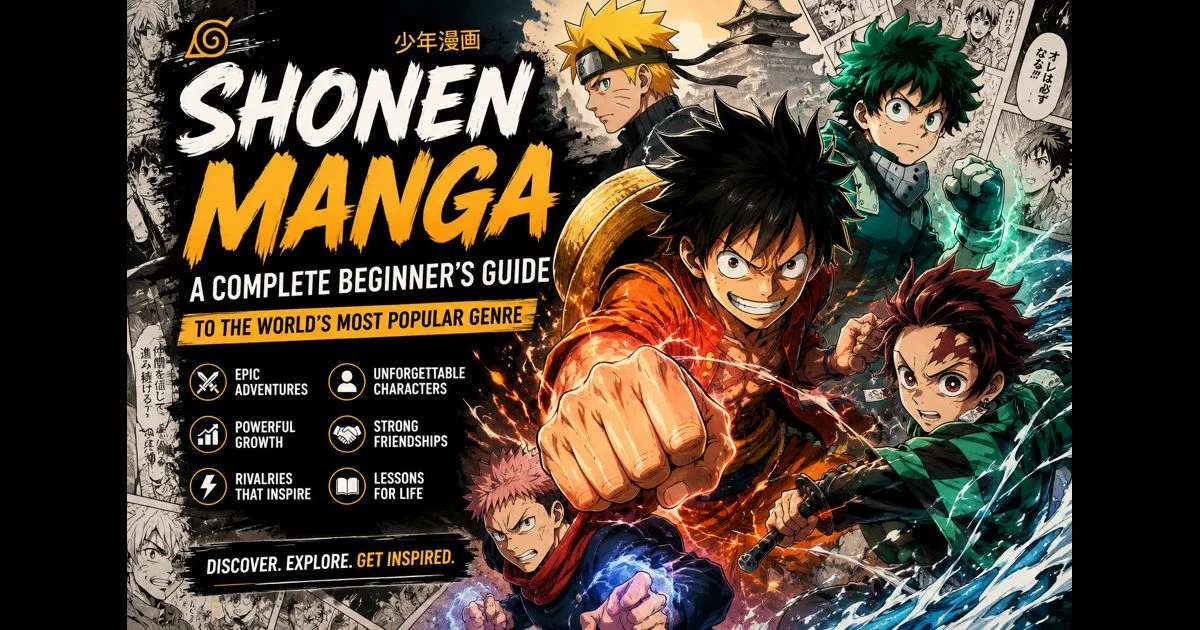
Shonen, also written shounen, identifies manga marketed primarily to boys and teenage male readers. Action, sports, comedy, romance, mystery, and everyday-life stories can all appear in shonen publications. Friendship and perseverance are common themes, not requirements.
Shojo
Shojo, also written shoujo, identifies manga marketed primarily to girls and teenage female readers. Romance is prominent in many shojo titles, but fantasy, horror, historical drama, action, and science fiction also belong within the category.
Seinen
Seinen identifies manga marketed primarily to adult male readers. It covers a wide range of tones and subjects, from quiet daily life and comedy to business drama, sport, history, and complex speculative fiction. It does not automatically mean graphic or unsuitable for younger readers.
Josei
Josei identifies manga marketed primarily to adult female readers. It can include workplace stories, family drama, fantasy, romance, comedy, historical fiction, and other genres. Mature characterization is common, but no single theme defines the category.
Demographic, genre, and rating are different
These three labels answer different questions:
|
Label type |
What it describes |
Examples |
|
Demographic |
The readership primarily targeted by the publication |
Shonen, shojo, seinen, josei |
|
Genre |
The kind of story or storytelling tradition |
Fantasy, romance, mystery, sports |
|
Age rating |
A content-suitability recommendation |
All ages, teen, older teen, mature |
Confusing these systems leads to unreliable recommendations. Readers choosing a title should consider its premise, content notes, edition, and publisher rating rather than relying on a demographic label alone.
Common Manga Genres and Story Types
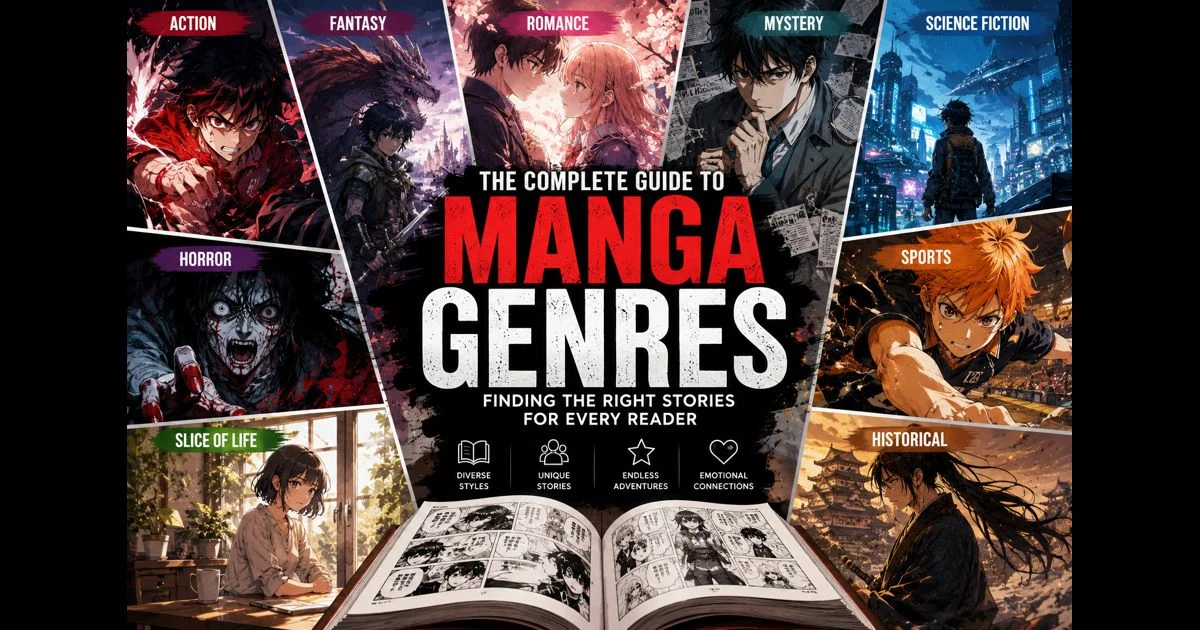
Manga genres can cross every demographic. A sports series may be shonen, shojo, seinen, or josei; fantasy and romance are similarly broad.
Isekai
Isekai means another world. An isekai story sends or places a protagonist in a world different from their original one, often through transportation, summoning, reincarnation, or a game-like setting. Not every fantasy story is isekai; the connection between worlds is usually central to the premise.
Mecha
Mecha refers to stories featuring mechanical technology, especially large piloted machines or robots. The machines may be the main attraction, but many mecha stories concentrate equally on politics, war, identity, teamwork, or the consequences of technology.
Magical girl
Magical girl, or maho shojo, centers on girls or young women with magical abilities, transformations, or special responsibilities. The category can include adventure, comedy, romance, drama, or darker reinterpretations.
Slice of life
Slice of life focuses on ordinary routines, relationships, school, work, family, or small personal experiences. It may have minimal conflict, but careful characterization and atmosphere can still create a strong narrative progression.
Iyashikei
Iyashikei, often translated as healing, is a calming branch of slice-of-life storytelling. It typically emphasizes restorative settings, gentle routines, companionship, and low-intensity conflict.
Gag manga
Gag manga prioritizes jokes, comic situations, wordplay, visual exaggeration, or recurring humorous patterns. Some gag series are episodic, while others develop continuing characters and plots.
Sports manga
Sports manga uses athletic training, competition, teamwork, rivalry, and personal development as central story elements. It can portray real sports closely or heighten movement and strategy for dramatic effect.
Creation and Artwork Terms
The manga creation process varies between solo creators, writer-artist teams, studios, magazines, and digital platforms. The following words describe common roles and production elements rather than one mandatory workflow.
Mangaka
A mangaka is a manga creator. One person may write and draw the series, while another project may credit a separate original writer, artist, designer, or supervisor. Translating mangaka simply as artist can therefore hide part of the role.
Gensakusha
A gensakusha is the original author or originator of a work. In a manga created by a team, this credit often identifies the writer whose story the artist adapts into comics form.
Name or nemu
A name, sometimes romanized nemu, is the manga storyboard or page draft. It maps panel layout, dialogue, action, and page turns before finished artwork is produced. It is closer to a visual blueprint than a list of character names.
Manuscript
A manuscript is the completed or production-ready set of manga pages submitted for publication. In digital workflows, the term still refers to the finished page files even when no physical paper original exists.
Assistant
A manga assistant supports production under the lead creator's direction. Tasks may include backgrounds, tones, effects, cleanup, reference preparation, or other page work. Duties and credit practices differ among studios.
Editor
A manga editor works with the creator on story development, clarity, pacing, scheduling, and publication requirements. The editor may provide close creative feedback, but the balance of responsibilities varies by creator and publisher.
Screentone
Screentone creates areas of gray, texture, pattern, light, or shadow in primarily black-and-white artwork. It was traditionally applied with adhesive sheets; digital tools now reproduce and extend the technique.
Speed lines
Speed lines are directional marks that suggest motion, force, focus, or emotional intensity. Their density and direction help guide the eye and influence how quickly a panel feels.
Line art
Line art is the finished drawing made primarily from lines before tones, color, lettering, and some effects are added. Line weight can distinguish depth, material, movement, lighting, and emphasis.
Chibi
Chibi describes a highly simplified, small-bodied character style, often with an enlarged head. Artists use it for comedy, cuteness, reaction images, merchandise, or a temporary shift in tone rather than as a literal change in a character's body.
Decompression
Decompression is storytelling that gives an action, exchange, or mood more panels and pages. It can slow time, build tension, emphasize small reactions, or let a setting breathe.
Translation, Localization, and Availability Terms
Translation
Translation converts the written meaning from one language into another. Manga translation involves dialogue, captions, signs, sound effects, jokes, wordplay, and cultural references rather than speech balloons alone.
Localization
Localization adapts translated material for readers in a particular language or region. Choices may involve idioms, units, jokes, honorifics, name order, explanatory notes, and age-appropriate wording. Good localization aims to preserve meaning, character voice, and reading clarity.
Lettering
Lettering places and styles translated dialogue, captions, and effects on the page. Font, size, spacing, balloon fit, and emphasis all affect tone and legibility.
Retouching
Retouching edits artwork where text must be removed or replaced. A retoucher may reconstruct a background hidden beneath Japanese lettering so translated text can sit naturally on the page.
Honorifics
Honorifics are suffixes and titles that communicate social relationships. Familiar examples include -san, -chan, -kun, -sama, sensei, and senpai. A translation may retain them, translate their function, or express the relationship through surrounding dialogue.
Licensed release
A licensed release is published with authorization for a specified language, format, and territory. Licensing rights can differ between print, digital, subscription, and other editions, so availability is not always identical across countries.
Official release
An official release comes from the rights holder or an authorized publishing partner. It generally includes credited translation and production work and provides a legitimate commercial route to the title.
Simultaneous publication or simulpub
A simulpub is a translated chapter released at or near the time of its original-language publication. The exact timing and territories depend on the publisher and platform.
Raws
Raws are pages in their original, untranslated form. In fan discussions the word often refers to unofficially obtained scans, but it can also be used more broadly for original-language material. The source and distribution rights still matter.
Scanlation
Scanlation combines scanning and translation. It describes a fan-made edition created by scanning pages, translating text, editing artwork, and adding new lettering. Most scanlations are distributed without permission and should not be confused with licensed digital manga or a publisher-approved fan project.
Fandom and Community Terms
Doujin and doujinshi
Doujin describes people or groups united by a shared creative interest and can also refer to self-published work. Doujinshi is a self-published book or magazine. Some doujinshi use existing characters, while others are completely original; the word does not automatically mean either fan fiction or commercial manga.
Comiket
Comiket, short for Comic Market, is a major Japanese marketplace centered on doujin works. It is associated strongly with self-publishing circles rather than conventional bookstore releases.
Otaku
Otaku refers to someone with an intense interest in a subject. In English-language manga fandom it is often used casually or proudly, while its tone in Japanese can be more context-dependent and sometimes negative. It should not be treated as a neutral label for every manga reader.
Cosplay
Cosplay is the practice of creating or wearing a costume to represent a character. It can involve garment making, prop construction, performance, photography, and community events.
Canon
Canon is material accepted as part of a story's official continuity. Disagreement can arise when manga, anime, novels, games, and creator comments present different versions of events.
Headcanon
A headcanon is a reader's personal interpretation or belief about a story that is not confirmed by official material. It can fit canon, extend it, or deliberately imagine an alternative.
Ship
A ship is a relationship that a fan supports or enjoys imagining. The relationship may be canonical, implied, unlikely, or entirely fan-created. Shipping does not make a pairing part of the official story.
Fan art and fan fiction
Fan art is artwork created by fans in response to an existing work. Fan fiction uses prose or comics to create unofficial stories based on existing characters or settings. Both belong to wider manga culture and community, but their legal and platform rules vary.
Spoiler
A spoiler reveals information that could reduce the intended surprise of a story. Chapter numbers and edition differences matter because readers may be at different points even when discussing the same title.
Manga, Anime, Manhwa, Manhua, and Webtoons
These words identify different media or publishing traditions:
|
Term |
Usual meaning in English-language publishing |
|
Manga |
Comics from Japan |
|
Anime |
Animation from Japan |
|
Manhwa |
Comics from Korea |
|
Manhua |
Comics from China or Chinese-language comics, depending on context |
|
Webtoon |
A digital-comics format or platform-associated label, often linked with vertical scrolling and Korean publishing |
The distinctions are about origin, medium, and format, not quality. A manga can receive an anime adaptation; a manhwa can be printed in volumes; and a comic from any tradition can be published digitally. The practical differences between manga, manhwa, and manhua include reading direction, language, production market, color use, and release format, but none of those traits works as an absolute rule by itself.
Romanization and Alternate Spellings
Japanese words can appear in several English spellings because romanization systems and publisher style guides differ. Long vowels may be shown with a macron, represented by an added letter, or omitted:
|
Common forms |
Same underlying term |
|
Shonen, shounen |
Shonen |
|
Shojo, shoujo |
Shojo |
|
Yonkoma, 4-koma |
Four-panel manga |
|
Tankobon, tankoubon |
Collected book format |
|
Doujinshi, dojinshi |
Self-published book or magazine |
A spelling variation does not necessarily signal a different category. When buying a volume or checking a release, the title, creator, publisher, edition, and ISBN are more reliable identifiers than romanization alone.
Frequently Asked Questions
Is shonen a manga genre?
No. Shonen is primarily a target-readership category. A shonen manga can belong to action, romance, comedy, mystery, sport, fantasy, or several genres at once.
Does seinen always mean mature content?
No. Seinen identifies the adult male readership targeted by a publication. Individual titles range from gentle comedy and daily life to complex drama, so the publisher's age rating and content information remain more useful for suitability.
Is a tankobon the same as a manga volume?
In English-language manga discussion, tankobon commonly refers to a collected manga volume. More precisely, it is a Japanese standalone book format and is not exclusive to manga.
Why does manga read “backward”?
It is not backward in its original design. Japanese manga commonly follows a right-to-left page and panel sequence. Translated editions preserve that composition so the artwork does not need to be mirrored.
Is anime another word for manga?
No. Manga is comics; anime is animation. They can tell versions of the same story, but each is a separate medium with its own pacing, production, and sometimes continuity.
Are manhwa and manhua types of manga?
They are related comics traditions, but English-language publishing normally uses manga for Japanese comics, manhwa for Korean comics, and manhua for Chinese or Chinese-language comics.
What does “Vol.” mean on a manga cover?
“Vol.” abbreviates volume. The number identifies a collected book in a series, not a single chapter or season of an anime adaptation.
What is the difference between a one-shot and a one-volume manga?
A one-shot is created as a single self-contained installment. A one-volume manga is a complete book and may contain one long work, several chapters, or a collection of separate stories.
Final Reference Point
Manga vocabulary becomes easier when each word is placed in the right system. Panels, gutters, and spreads describe the page; chapters, serialization, and tankobon describe publication; shonen, shojo, seinen, and josei describe target readership; and isekai, mecha, romance, or mystery describe the story. Keeping those categories separate prevents the most common misunderstandings and makes publisher listings, reviews, release announcements, and community discussions much easier to follow.