Psycho horror manga is the quietest corner of horror — and often the most frightening. There is no masked killer chasing teenagers through a house, no river of blood on page after page. Instead there is a character slowly losing their grip on reality, a town that feels wrong in a way nobody can explain, or a story that makes perfect sense until the final page, when it suddenly does not. The fear does not come at you. It grows inside you while you read.
This guide explains what psycho horror manga is, how it differs from gore and slasher horror, the psychological themes it returns to, the landmark titles every reader should know, and where to start. If you are still finding your footing in horror manga generally, our complete horror manga guide is a good place to begin.
What Is Psycho Horror Manga?
Psycho horror manga is horror built from the mind rather than the body. The threat is not a monster or a murderer but a breakdown: a memory that cannot be trusted, a personality splitting apart, a reality that bends a little more with every chapter. The scares come from paranoia, obsession, guilt, identity and dread — the fears of real life, drawn out to their most extreme conclusions.
A typical psycho horror manga starts in a world that looks normal. The art is often clean, even beautiful, which is precisely the point. The horror creeps in through small wrongnesses: a character repeats a sentence they have already said, a familiar room has one extra door, a friend’s smile lasts a fraction too long. Nothing has attacked anyone yet, but the reader already feels uneasy.
Psycho Horror Manga vs. Gore and Slasher Horror
New readers often lump all horror manga together, but the subgenres scare different parts of the brain. Gore horror, sometimes called splatter, is direct and physical: it shows the body breaking and trusts the image to shock. Slasher horror is a chase: a killer, a victim, a countdown. Both are honest about what they are.
Psycho horror manga works the other way round. The fear is slow, ambiguous and internal. A character may never be in physical danger at all — and yet the story is terrifying, because their mind is the danger. The horror is not that someone will die, but that someone has already lost themselves and has not noticed yet.
| Subgenre | Main Threat | How It Scares You | Best Starting Point |
|---|---|---|---|
| Psycho horror manga | The mind: paranoia, obsession, fractured identity | Slow dread and unreliable reality | Uzumaki by Junji Ito |
| Gore / splatter horror | Violence done to the body | Graphic imagery designed to shock | Panorama of Hell by Hideshi Hino |
| Slasher horror | A killer hunting victims | Suspense, chases, sudden violence | The Drifting Classroom by Kazuo Umezu |
| Ghost / supernatural horror | Spirits, curses, the afterlife | Atmosphere and the unseen | The Kurosagi Corpse Delivery Service by Eiji Otsuka |
| Folk horror | Cursed villages, old traditions | Isolation, ritual, hidden secrets | Higurashi When They Cry by Ryukishi07 |
| Body horror | The body changing into something else | Disgust at flesh breaking its rules | Parasyte by Hitoshi Iwaaki |
The borders between these categories are soft, and the best titles cross them freely. Uzumaki is psycho horror manga at its core, but it has moments of pure body horror. What matters is the engine: if the story’s fear comes from inside a character’s head, you are reading psycho horror manga.
The Psychological Themes That Define the Genre
Paranoia: everyone knows something you do not
Paranoia is the genre’s most reliable engine. A character begins to suspect that the people around them are lying, watching or plotting — and the story refuses to tell you whether they are right. The brilliance of manga as a medium here is visual: the artist can draw the same scene twice, once as the character sees it and once as it really is, and let the reader notice the difference. A crowd scene with one face turned the wrong way, a background character who appears in two places at once — these tiny details make the reader paranoid too.
Identity: who are you when you cannot trust yourself?
Many of the genre’s best stories are about identity coming apart. A character wakes up in a life that is almost theirs, meets a double, or slowly realises that the person in the mirror is not quite them. Junji Ito’s Tomie is the purest example: a girl who cannot die, who returns again and again, and who drives everyone who loves her to violence. The horror is not that Tomie is a monster. It is that she is beautiful, charming and endlessly replaceable.
Dread: the fear that something bad is coming
Dread is different from a scare. A scare is sudden; dread is slow. Psycho horror manga is built on dread: long stretches of ordinary life where something is slightly off, and the reader waits for the other shoe to drop. The artist controls this with pacing — wide, quiet panels, long silences between lines of dialogue, a corridor that takes three pages to walk down. The payoff, when it comes, is often quieter than the build-up. The worst thing in a psycho horror manga is rarely what happens. It is the realisation that it was always going to happen.
Unreliable reality: the world itself cannot be trusted
The most ambitious psycho horror manga does not just give you an unreliable narrator — it gives you an unreliable world. The rules of the story change without warning: time loops, places repeat, dead characters return without explanation. In Uzumaki, an entire town becomes obsessed with spirals, and the obsession is treated as both a psychological breakdown and a physical fact. Is the town cursed, or is everyone in it going mad together? The story never answers, and that refusal is the horror. Our guide to mystery and psychological manga explores how these stories use unanswered questions as their main weapon.
Landmark Titles Every New Reader Should Know
Uzumaki, by Junji Ito, is the single best starting point. A seaside town is slowly consumed by spirals — in hair, in smoke, in architecture, in bodies — and the townspeople’s obsession grows with every chapter. It is the clearest demonstration of the genre’s core trick: a perfectly ordinary world, drawn with beautiful precision, coming apart one small wrongness at a time. Read it slowly; the horror is in the background details as much as in the plot.
Tomie, also by Ito, is the character-driven counterpart: a series of short stories about a girl who cannot die and who inspires obsession and murder wherever she goes. Read it as a set of linked nightmares rather than one long plot. The artists behind these works are worth knowing in their own right — our guide to the horror manga artist explains how creators like Ito build fear with ink and panel rhythm.
Higurashi When They Cry, by Ryukishi07, looks at first like a gentle story about friends in a small village — and then it fractures into timelines, paranoia and murder, told and retold from different points of view. It is the best introduction to the genre’s love of unreliable storytelling.
Homunculus, by Hideo Yamamoto, is the most purely psychological title on this list. A homeless man agrees to an experimental brain surgery and begins to see people’s hidden traumas as grotesque distortions of their bodies. There are almost no supernatural elements at all. The horror is entirely human: what people hide, what they fear, and what happens when someone can finally see it.
How to Read Psycho Horror Manga
First, slow down. This is not a genre to binge at speed. The dread is built in the quiet panels, the repeated backgrounds, the tiny detail that changes between two nearly identical drawings. If you rush, you will miss the exact moments the story is trying to show you. Read one volume at a time, and give yourself a day to sit with it before the next.
Second, look at the art, not just the plot. In psycho horror manga, the drawing is doing half the storytelling. Watch the backgrounds: an artist who draws a room slightly differently each time it appears is telling you something about the character who lives there. Watch the faces: a smile held one beat too long, eyes that look in different directions. These are not mistakes. They are the story.
Third, accept that you will not get all the answers. Psycho horror manga is comfortable with ambiguity in a way most genres are not. A story may end without explaining what was real or whether the horror has truly ended. That is not a flaw in the writing — the uncertainty is the point.
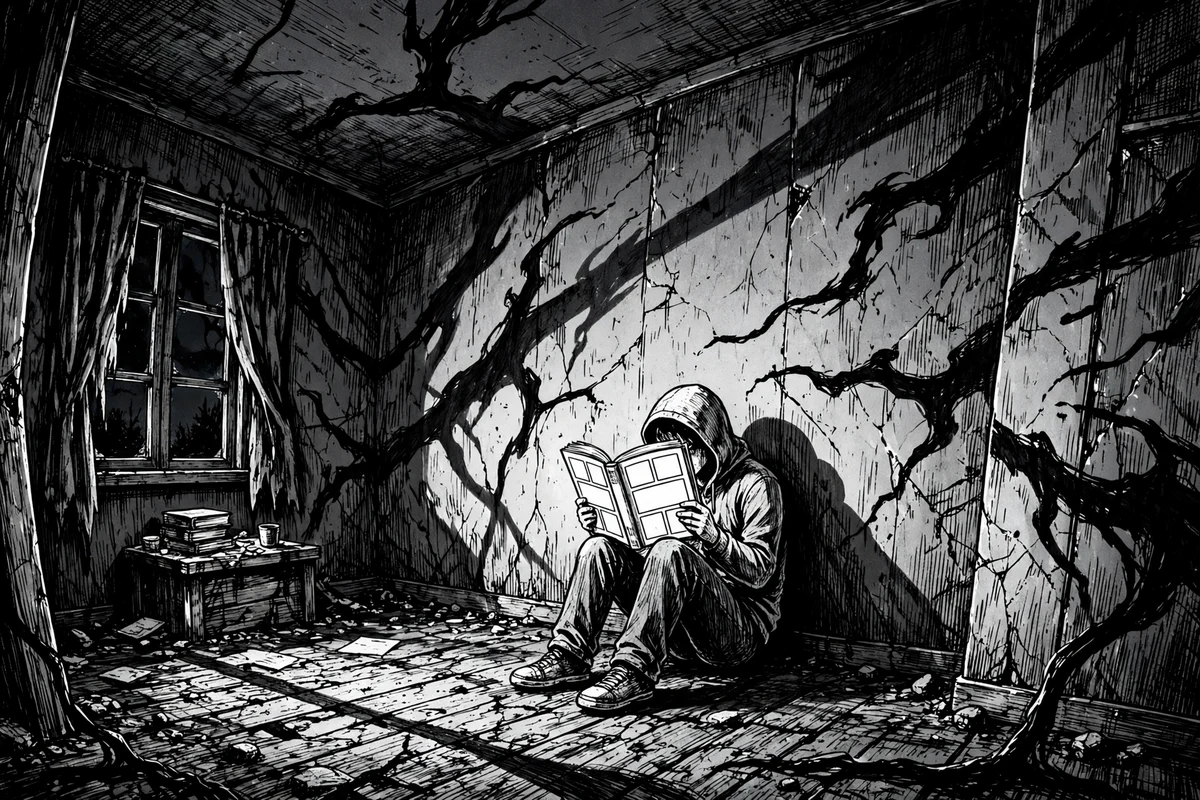
Finally, read in the right setting: alone, at night, with no distractions. The genre works by getting inside your head, and it works better when your head is quiet. A single lamp, a comfortable chair, a book you can hold in both hands — that is all you need.
Where to Start: A Simple Reading Order
Start with Uzumaki, one volume, to learn what the genre feels like at its best. Then read a few chapters of Tomie to see the same craft applied to a character instead of a place. Third, pick up Higurashi When They Cry for a long, twist-filled story, or Homunculus for something quieter and more psychological. After that, follow the creator, not the genre: if you loved Ito, read everything of his you can find.
One warning is worth repeating. Psycho horror manga can be genuinely disturbing, and not only because of gore — the psychological content itself can be heavy. Some classic works deal with suicide, self-harm, abuse and severe mental illness. Check content notes before you buy, and put a book down if it feels cruel rather than frightening.
Why Psycho Horror Manga Stays With You
Most horror is forgotten the moment the lights come back on. Psycho horror manga is not. It stays with you because it does not frighten you with something outside yourself — it frightens you with the idea that your own mind might not be reliable. That is a fear no monster can match, and it is why a black-and-white drawing of a spiral, a mirror or a shadow can feel more frightening than any special effect.
Start with one volume, read it slowly, and pay attention to the panels that make you pause before turning the page. That pause is the whole genre, working exactly as it should.