Every manga reader remembers their first series. It might have been borrowed from a friend or spotted on a library shelf. One volume in, and suddenly hundreds of stories are waiting. Starting manga is easy. Starting with the right manga is what turns a one-week hobby into one that lasts for years.
This guide covers how manga actually reads, how to pick a first series that fits your taste, what to expect from a first volume, and which well-loved series make the best starting points across every major genre.
How to Read Manga: Right to Left, Panels, and Volumes
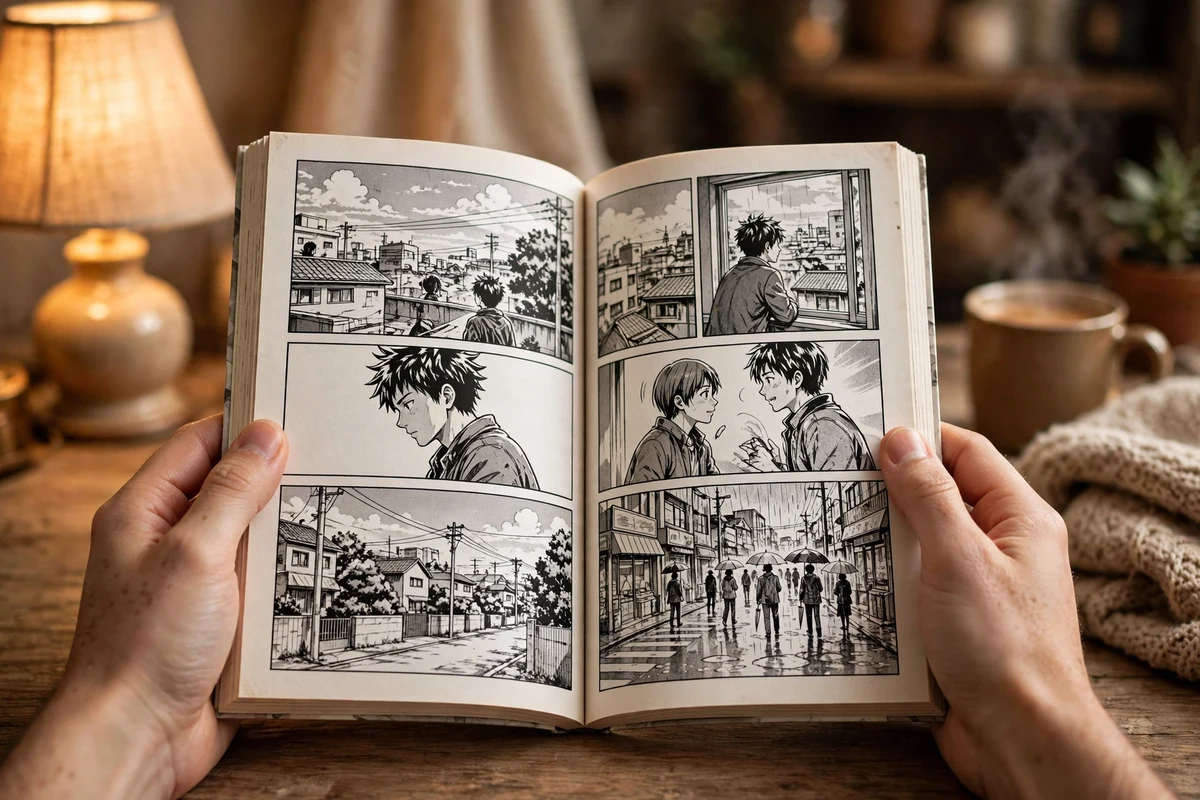
The first thing that surprises new readers is the direction. Manga reads right to left: start at the top-right panel, work your way left, then down to the next row. Speech bubbles follow the same order. It feels strange for about ten pages, then your eyes adjust. Most volumes include a short note at the start explaining the reading order.
A manga volume is a collected book of around 180 to 200 pages, made up of chapters of about 20 pages each. When people call a series “long”, they mean it has many volumes: One Piece by Eiichiro Oda has run since 1997 and has well over a hundred, while Death Note by Tsugumi Ohba and Takeshi Obata (2003-2006) tells its whole story in twelve. As a beginner, a shorter complete series is the kinder choice, because you get a real ending without a year-long commitment.
The art does a lot of the storytelling. The size, angle, and spacing of a panel set the pace: a full-page spread means a big moment, while small, tight panels mean tension or speed. You do not need to study this to enjoy it. Just slow down and let the art breathe, especially in quiet scenes, where an expression can say more than a page of words.
Pick by Mood, Not by Popularity
The most common beginner mistake is starting with whatever is most popular. Popularity is a useful signal, but it is not a match: a series can be the biggest thing in the world and still be wrong for you if its tone does not fit your mood. The better question is simple: what do you already enjoy in films, books, or television?
If you like fast-paced action and underdog heroes, shonen is your home. If you want something gentle, slice of life will suit you. If you love a good puzzle, mystery manga will keep you turning pages. Romance, fantasy, horror, and sports each have their own flavour, and our complete guide to manga genres maps them all in one place.
Think about length too. A 12-volume series you finish in a month teaches you what you like far better than a 100-volume epic you abandon at volume three. You can always graduate to the long epics later, once you know your taste.
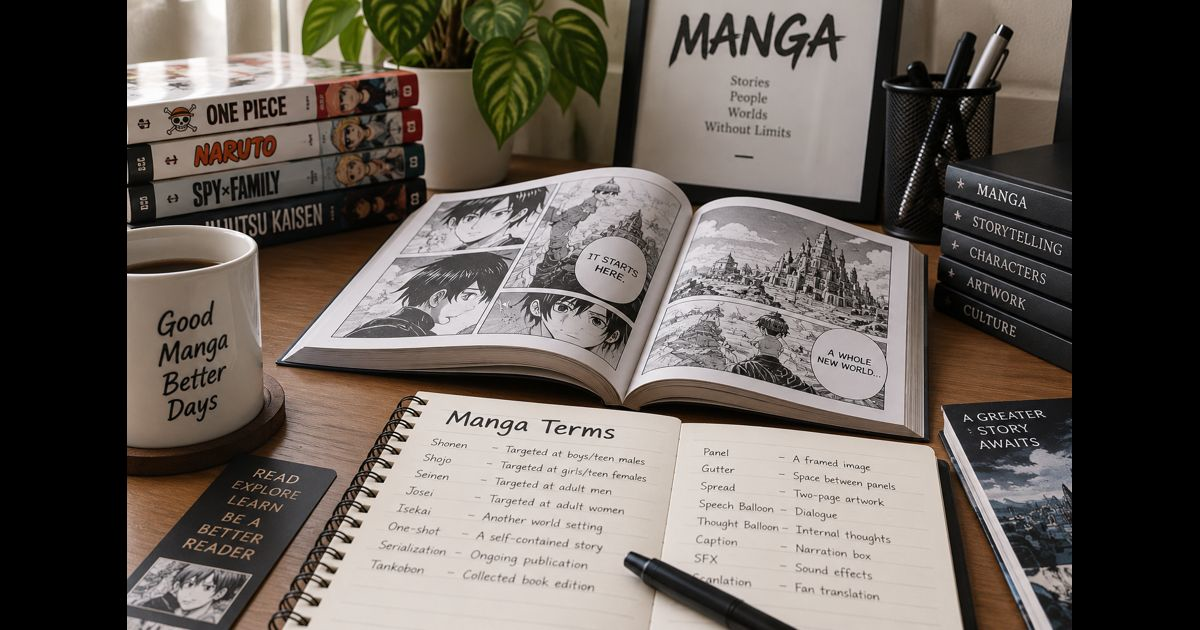
Finally, consider the age rating, printed on the back of the volume. Shonen and shojo are aimed at teenagers, while seinen and josei are written for adults. The difference is not just content; it is themes, pacing, and the kind of story being told. Our comparison of shonen and seinen explains how the two audiences shape very different reading experiences.
Starter Picks for Every Taste
The table below gives one safe, well-loved starting point for each major genre. Every series here is a real, widely praised manga, and each one is easy to find in print or through a library.
| Genre | Why Beginners Love It | Start With |
|---|---|---|
| Shonen Action | Clear hero, rising stakes, fights that mean something | Demon Slayer by Koyoharu Gotouge (2016-2020) |
| Slice of Life | Gentle, funny, and relaxing; easy to follow | Yotsuba&! by Kiyohiko Azuma (2003-ongoing) |
| Romance | Warm, funny, and honest about two people figuring things out | Horimiya by HERO and Daisuke Hagiwara (2011-2021) |
| Fantasy | A complete world with a beginning, middle, and satisfying end | Fullmetal Alchemist by Hiromu Arakawa (2001-2010) |
| Mystery and Psychological | A battle of wits; every chapter ends on a question | Death Note by Tsugumi Ohba and Takeshi Obata (2003-2006) |
| Comedy | Laugh-out-loud funny, with a family you will care about | Spy x Family by Tatsuya Endo (2019-ongoing) |
| Sports | Underdog energy, teamwork, and matches that feel like finals | Haikyu!! by Haruichi Furudate (2012-2020) |
| Dark Fantasy and Horror | Huge scale, real danger, and questions that stay with you | Attack on Titan by Hajime Isayama (2009-2021) |
| Drama | A quiet, emotional story about guilt, forgiveness, and growing up | A Silent Voice by Yoshitoki Oima (2013-2014) |
A few of these deserve a closer look. Demon Slayer is the safest action pick: complete at 23 volumes, fast-moving, and the first volume tells you exactly what kind of series it is. Yotsuba&! is the opposite end of the spectrum: a little girl discovering everyday life, with almost no plot at all, and one of the most relaxing reads in manga. In between, Spy x Family gives you comedy, action, and heart in a single series. For depth, Fullmetal Alchemist is often called the best complete manga ever made, and Attack on Titan starts as a simple fight for survival and grows into one of the most talked-about stories in the medium.
Use the table as a starting map, then follow your own taste. If you loved the gentle pace of Yotsuba&!, try our slice-of-life manga guide. If Horimiya made you smile, our romance manga guide has thirteen landmark series to explore. And if Fullmetal Alchemist pulled you in, our fantasy manga guide is the natural next step.

What to Expect From Your First Volume
A first volume is an introduction, not a full story. It sets up the world, introduces the main characters, and ends on a hook that makes you want volume two. Do not judge a series by its first chapter alone: many great manga take two or three chapters to find their rhythm.
Expect to read more slowly than you would a novel. Manga pages carry art, dialogue, sound effects, and silence all at once, and rushing means missing half the story. A single volume takes most readers 45 minutes to an hour. If you finish in twenty minutes, you probably skimmed the art.
It is also normal to feel lost for the first few pages. New names, new places, and an unfamiliar reading direction will all slow you down. That feeling passes quickly: by the second volume the world feels familiar.
Where to Get Your First Manga
You do not need to buy a whole series before you know whether you like it. Start with volume one, and only continue if you want more. Most bookshops stock the popular starters, and many libraries carry manga you can borrow for free, which is the best way to try several genres without spending anything.
Digital reading is a good option too. Official apps let you read on a phone or tablet, often with free first chapters, so you can check whether a series clicks before buying physical volumes. Stick to official sources: they pay the creators, the translations are better, and the reading experience is cleaner.
If you fall in love with a series, physical volumes are worth collecting: they look good on a shelf, they are easy to lend, and they never need charging. A full series takes up real space, though, so many readers mix the two: physical copies for favourites, digital for everything else.
Beginner Mistakes to Avoid
The first mistake is starting five series at once. It blurs the stories together and you end up finishing none of them. Pick one, read the first three volumes, and then decide: three volumes is enough to know whether a series is for you.
The second mistake is skipping ahead. Manga rewards patience, and spoilers are everywhere online, from video titles to thumbnail images. Stay away from wiki pages and discussion threads until you are caught up: the twists land much harder when you do not see them coming.
The third mistake is assuming that long means better. One Piece and Naruto by Masashi Kishimoto (1999-2014) are both wonderful, but a beginner does not need to start with a hundred volumes. Shorter series like Death Note, A Silent Voice, and Your Lie in April by Naoshi Arakawa (2011-2015) deliver a complete story in a weekend.
The fourth mistake is ignoring the rest of a genre you enjoy. If you liked the tension in Death Note, our mystery and psychological manga guide has more of the same mind games. If the team spirit of Haikyu!! hooked you, our sports manga guide covers the best of the genre. And if Attack on Titan left you wanting more dread, our horror manga guide is the place to look.
Finally, do not worry about demographic labels. A shojo series can be loved by anyone, and a seinen drama like Vinland Saga by Makoto Yukimura (2005-ongoing) can move a teenager. Our seinen manga guide and josei manga guide explain what those labels mean, but the only rule that matters is this: follow the story, not the shelf it was placed on.
Frequently Asked Questions
What is the best manga for a complete beginner?
Demon Slayer is the safest first pick for action fans: complete, fast, and easy to follow. For something gentle, start with Yotsuba&!, and for laughs, Spy x Family is hard to beat.
Do I need to read manga right to left?
Yes, that is how manga is printed: top-right panel first, then left, then down. It feels strange for a few pages, then becomes automatic. Most volumes include a short guide at the start.
How long does it take to read one manga volume?
Most readers take 45 minutes to an hour for a standard volume of about 200 pages. Reading more slowly is fine: the art carries a large part of the story.
Should I start with a long series like One Piece?
Not as your very first manga. Start with a shorter complete series so you learn what you enjoy, then move on to the long epics.
Is manga only for teenagers?
No. Manga is made for every age group, from children to adults. Seinen and josei series are written specifically for adult readers.